Readers Theater Worksheets
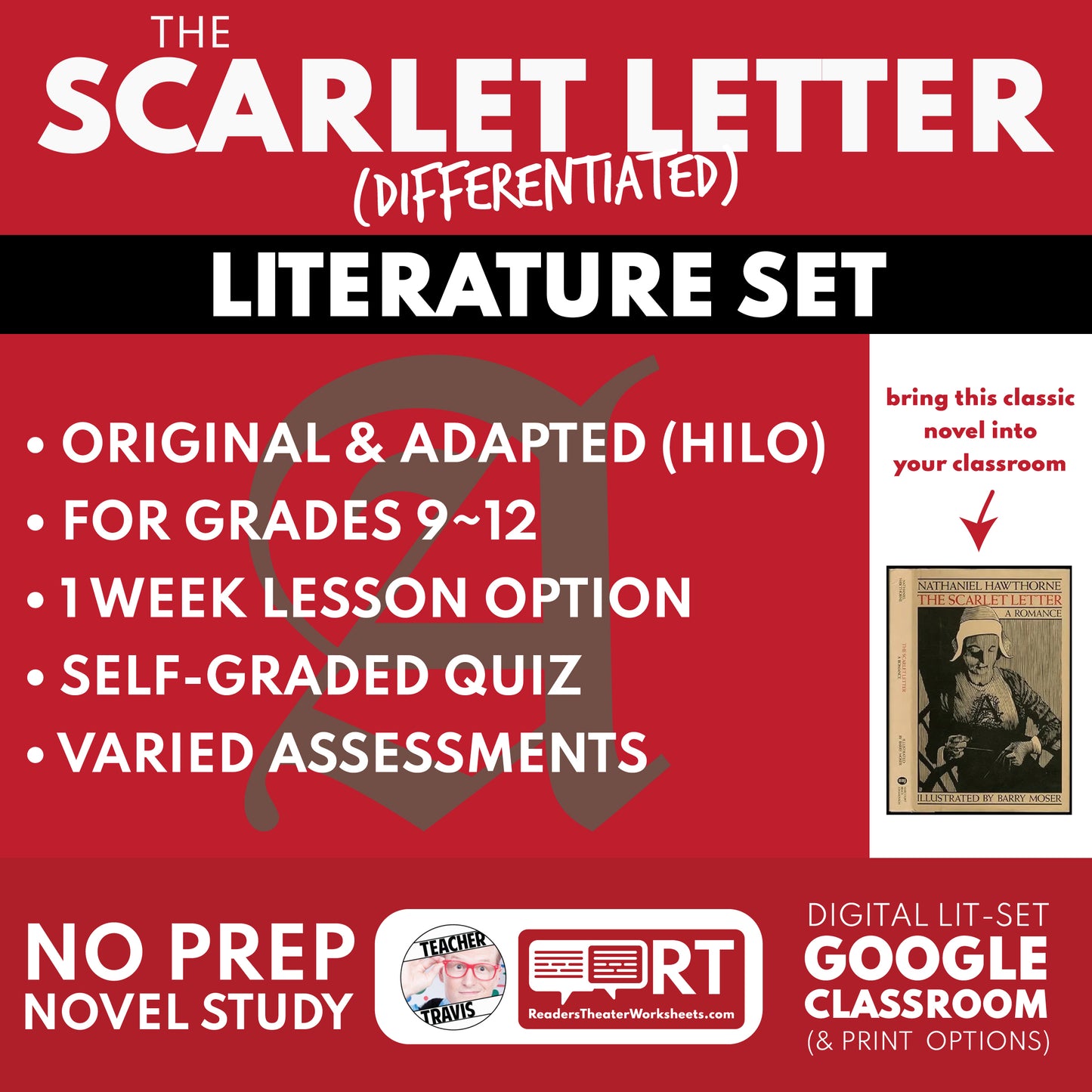
The Scarlet Letter Differentiated Novel Study | ELA Literature | Hawthorne Lit Set for High School
The Scarlet Letter Differentiated Novel Study | ELA Literature | Hawthorne Lit Set for High School
Couldn't load pickup availability
Classroom Use at a Glance
A no-prep differentiated literature study guide for high school students with reading, comprehension, vocabulary, discussion, writing, quiz, and teacher support materials. Designed for mixed-ability ELA classes, close reading, literature discussion, assessment, and differentiated instruction.
Classroom Uses Whole Class, Small Groups, Close Reading, Discussion, Assessment, Review, Enrichment, Sub Plan view all
- Whole Class
- Small Groups
- Close Reading
- Discussion
- Assessment
- Review
- Enrichment
- Sub Plan
Included Original Text, Teacher Guide, Student Worksheet, Answer Key, Quiz, Google Forms Quiz, Vocabulary, Discussion Questions, Challenge Questions, Writing Prompt view all
- Original Text
- Teacher Guide
- Student Worksheet
- Answer Key
- Quiz
- Google Forms Quiz
- Vocabulary
- Discussion Questions
- Challenge Questions
- Writing Prompt
Format PDF, DOCX, Google Docs, Google Forms, Printable, Editable view all
- DOCX
- Google Docs
- Google Forms
- Printable
- Editable
Differentiation Leveled Version, Original Version, Mixed Reading Levels, Vocabulary Support, Short Sections view all
- Leveled Version
- Original Version
- Mixed Reading Levels
- Vocabulary Support
- Short Sections
Problem: Teaching a classic novel can feel like an impossible tradeoff: you want students to wrestle with real themes and craft, but the original language and length can overwhelm mixed-level classes and turn planning into a time sink.
Here’s the solution: This differentiated novel study / digital lit-set solves that problem with a complete, classroom-ready package that includes the full original text of The Scarlet Letter and a five-part adapted version written for modern clarity. It is built for flexible pacing and mixed reading levels, with a stable part-for-part chapter map (Parts 1–5) so every class discussion and assessment aligns cleanly across both tracks. Original and adapted word counts and reading levels are included so you can place students appropriately and document rigor.
Every discussion question, multiple-choice exit quiz, short-answer item, and challenge question works for both tracks—students can cite evidence from either the original novel or the adapted version while you assess the same skills and standards with one unified set of materials.
Quick Guide for Teachers:
Adapted-Only Track (Fastest: 5-Day Model)
- Best for Grades 9–10 classes that need a manageable, one-week novel experience.
- Day 1–5: Students read one adapted part per day and use the matching Main Ideas & Themes Discussion Questions and self-grading multiple-choice quiz.
- End the week with the Final Worksheet (Vocabulary Words, Short Answer Questions, and Challenge Questions).
- This track keeps lessons tight, predictable, and complete in five days.
Original-Only Track (Longer: Multi-Day Per Section)
- Ideal for stronger readers or classes ready for original language and sentence structure.
- Students read the original chapters aligned to each adapted Part
- Use the same Discussion Questions, MC exit quizzes, and Final Worksheet; all items are text-accurate for both versions.
- Vocabulary Words (10) are usable for both tracks, because each word appears in both the adapted text and the corresponding original chapters.
- This track preserves the full descriptive style and classic voice while giving you ready-made, age-appropriate assessments.
Dual-Track Differentiation (Mixed Readers, Flexible Timelines)
Lets your entire class study the same plot, scenes, and themes at the same time—even when some students need the adapted text and others handle the full novel. Assign adapted Part 1 to students who need a shorter, clearer text and original corresponding chapters to students reading the full text; repeat this pattern through Parts 2–5 (timing will depend on your classroom's reading level) Give original-text students multiple days per section while adapted-text students reread key scenes, complete vocabulary tasks, and tackle discussion questions in pairs or small groups. All assessments are usable for both tracks: Discussion Questions, MC Exit Quizzes for each Part, and the Final Worksheet (Vocabulary, Short Answer, and Challenge Questions). What’s the Tradeoff of Using the Adapted Version?
Pros:
- Reduces the novel to a fraction of its original length, fitting neatly into a one-week unit.
- Well suited for shorter attention spans and developing readers in Grades 9-10
- Preserves core narrative elements, characters, and themes
- Far better than skipping the book entirely due to time limits or reading-level concerns.
- Works for whole-class read-alouds, small-group novel studies, independent reading, or focused close-reading lessons.
- Cons:
Omits some original language, side scenes, and descriptive passages for brevity, so students do not see every nuance of the original author's style.
Leaves fewer opportunities for deep line-by-line stylistic analysis than a full-length, multi-week novel study.
Bottom Line:
If you have the time and budget, nothing beats the feel of a real paperback in every student’s hands. But when time, copies, and reading levels are real constraints, a digital literature set like this—adapted text + original text mapping + shared assessments—lets you bring this classic novel into your classroom instead of leaving it on the “maybe someday” shelf. If you were to buy traditional paperbacks at about $7 per book for 30 students, that is a $210 investment. This digital lit-set gives you a reusable, print-friendly alternative you can adapt for many years and multiple groups.
Try a digital lit set first for FREE! (It's just like this one)
[FREE DOWNLOAD] The Great Gatsby Differentiated Novel Study | Lit Set
This product includes a zip file consisting of:
NOTE: All files are editable and include (PDF, DOCX, PPTX, Google Docs/Slides/Forms)
Full Original Text: 83,000 words | 11.0 Flesch-Kincaid GL
- Lexile Ranges: ~1050L – 1300L | CEFR ~B2
- Great for advanced readers (or Grades 11–12), extension groups, longer-term classic studies.
-
BONUS: Free Access to the text on our LEVELED-LIT CLASSICS Library Platform.
Adapted Version Text: 15,500 words | 8.0 Flesch-Kincaid GL
- Lexile Ranges: ~850L – 1050L | CEFR ~B1
- On-level Grade 8 readers
- Supported Grade 7 readers
- Divided into 5 parts for easy daily reading sessions
- *Both versions tell the same story, allowing students to participate in shared discussions even when reading different texts.
Student Final Worksheet/Quizzes (PPTX, Google Slides/Forms)
- 10 Vocabulary Words
- 10 Short Answer Recall/Comprehension
- 5 Challenge Questions (synthesis, analysis, themes, real life connection)
- 5 Multiple Choice Quizzes (20 Questions) (1 per part)
Teacher’s Guide & Answer Key
- 5 Sets of Daily Discussion Questions (1 per part)
- 5 Sets of Self-Graded Exit Quizzes (1 per part, 20Qs each)
- Answer Keys for Vocab, Short Answer, and Challenge Questions
- Key Figures & Places reference sheets to help students track characters and settings
Adapted Version Summary (and source chapters)
- Part 1 – The Public Sentence Adapted from: Intro + Chapters I–IV of the original novel. The story opens with a “found narrative” frame, then shifts into a public scaffold punishment that turns private sin into communal spectacle. Hester endures the crowd’s judgment while refusing to name the father, binding her fate to secrecy and moral pressure. A stranger’s recognition and demand for silence establishes a hidden agenda that will shape later events. A private confrontation closes the section by locking key relationships into place and intensifying the stakes.
- Part 2 – Survival, Power, and the Child Adapted from: Chapters V–VIII of the original novel. Hester survives through work and isolation, living on the colony’s edge while the scarlet letter becomes a permanent public identity. Pearl grows into a striking, difficult child whose presence keeps the story’s moral conflict active rather than settled. Institutions begin to tighten around Hester through questions of custody and legitimacy. In the governor’s hall, Hester must defend her right to raise Pearl, revealing how deeply her love and punishment are fused.
- Part 3 – Hidden Guilt and Quiet Revenge Adapted from: Chapters IX–XII of the original novel. A physician attaches himself to the minister, turning care into constant access and observation. The minister’s hidden guilt deepens into physical and emotional instability, and private self-punishment becomes a substitute for honest confession. The physician’s calm manner grows more threatening as it becomes clear he is studying weakness, not simply treating illness. A secret scaffold scene in the night sharpens the novel’s central tension between public holiness and private truth.
- Part 4 – Truth Spoken in the Wilderness Adapted from: Chapters XIII–XVIII of the original novel. Time alters Hester’s standing and sharpens her understanding of the colony’s moral theater. Recognizing the danger of silence, she confronts the physician’s role and chooses truth over protection. In the forest, away from public surveillance, she finally reveals what she has withheld, forcing the minister to face the real shape of his suffering. The section opens a fragile possibility of escape, but emphasizes how compromised hope becomes when it is built on delayed honesty.
- Part 5 – The Last Public Day Adapted from: Chapters XIX–XXIV of the original novel. Election Day transforms the town into ceremony and display, pushing private plans into a public timeline that cannot be controlled. Hester’s hoped-for escape is threatened as the physician maneuvers to keep his grip intact. After delivering a celebrated sermon, the minister makes a shocking public decision that forces truth into communal witness. The climax resolves the story’s moral argument by showing what confession can finally break—and what it cannot repair.
Frequently Asked Questions About the Adapted The Scarlet Letter Novel Study
Q: Can I use the adapted text with reluctant or below-level readers without losing rigor? A: Yes. The adapted version is a complete five-part text designed for modern clarity while preserving the novel’s moral complexity, symbolism, and character conflict. It is approximately 14,000 words at a Flesch-Kincaid Grade Level of 9.0, making it accessible for Grade 9 readers while still supporting evidence-based analysis.
Q: How does this resource align to CCSS for Grades 9–10? A: The tasks and questions are built around the RL.9–10 reading standards (text evidence, theme, character, craft/structure, and language), SL.9–10 discussion standards for collaborative analysis, and L.9–10 standards for academic vocabulary and meaning in context. The standards list is intentionally lean and tied directly to what students must do.
Q: How does differentiation work if some students read the original and others read the adapted version? A: The resource is mapped part-for-part to the original chapters (Parts 1–5), so the same discussions, exit quizzes, short answers, and challenge questions apply to both tracks. Students respond using evidence from whichever text they are assigned, while you assess the same skills with one unified set of materials.
This is a complete, no-prep unit that lets you teach The Scarlet Letter with one coherent assessment system while supporting mixed reading levels through a dual-track original-and-adapted design.
Get this in a Bundle of 10 Digital Lit Sets & SAVE 40%
CCSS Standards
Reading Literature: CCSS RL.9-10.1, CCSS RL.9-10.2, CCSS RL.9-10.3, CCSS RL.9-10.4, CCSS RL.9-10.5, CCSS RL.9-10.6, CCSS RL.11-12.1, CCSS RL.11-12.2, CCSS RL.11-12.3, CCSS RL.11-12.4, CCSS RL.11-12.5, CCSS RL.11-12.6
Speaking & Listening: CCSS SL.9-10.1, CCSS SL.11-12.1
Language: CCSS L.9-10.4, CCSS L.11-12.4
Anchor Standards: CCRA.R.1, CCRA.R.2, CCRA.R.3, CCRA.R.4, CCRA.R.5, CCRA.R.6, CCRA.W.1, CCRA.W.2, CCRA.W.9, CCRA.SL.1, CCRA.L.1, CCRA.L.2, CCRA.L.4
Share