
Readers Theater Worksheets
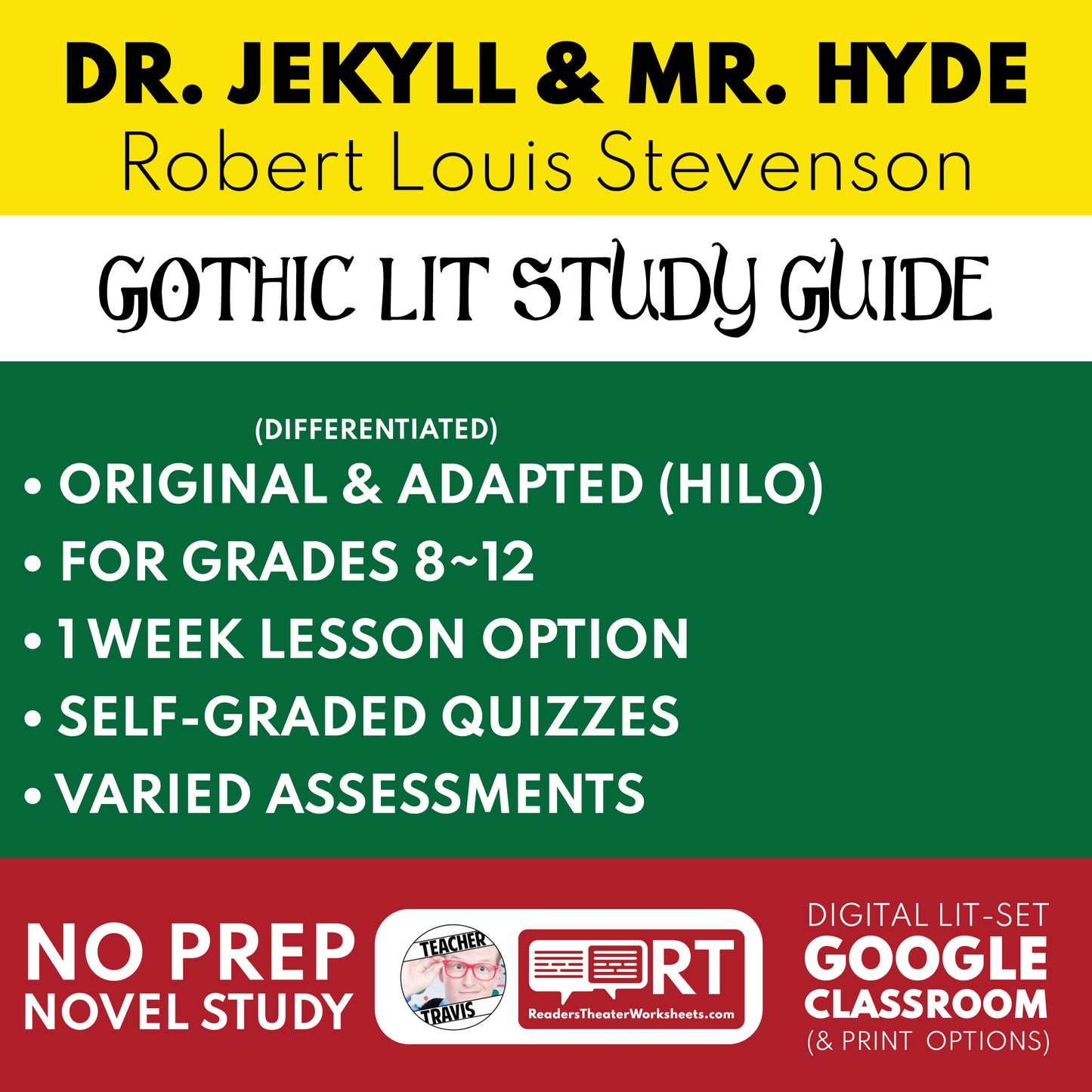
The Strange Case of Dr. Jekyll and Mr. Hyde by Robert Louis Stevenson | Differentiated Classical Goth Lit Study Guide for Grades 9–12
The Strange Case of Dr. Jekyll and Mr. Hyde by Robert Louis Stevenson | Differentiated Classical Goth Lit Study Guide for Grades 9–12
Couldn't load pickup availability
Classroom Use at a Glance
A differentiated literature study guide for mixed-grade ELA classes using The Strange Case of Dr. Jekyll and Mr. Hyde by Robert Louis Stevenson | Differentiated Classical Goth Lit Study Guide for Grades 9–12. Built to support mixed reading levels, close reading, vocabulary, discussion, assessment, and no-prep ELA instruction.
Classroom Uses Close Reading, Discussion, Assessment, Whole Class, Homework, Sub Plan view all
- Close Reading
- Discussion
- Assessment
- Whole Class
- Homework
- Sub Plan
Included Original Text, Leveled Text, Teacher Guide, Student Worksheet, Answer Key, Quiz, Google Forms Quiz, Vocabulary, Discussion Questions, Writing Prompt view all
- Original Text
- Leveled Text
- Teacher Guide
- Student Worksheet
- Answer Key
- Quiz
- Google Forms Quiz
- Vocabulary
- Discussion Questions
- Writing Prompt
Format PDF, DOCX, Google Docs, Google Forms, Online Library Access, Printable, Editable view all
- DOCX
- Google Docs
- Google Forms
- Online Library Access
- Printable
- Editable
Differentiation Original Version, Leveled Version, Mixed Reading Levels, Vocabulary Support, Struggling Readers, Advanced Readers view all
- Original Version
- Leveled Version
- Mixed Reading Levels
- Vocabulary Support
- Struggling Readers
- Advanced Readers
PROBLEM: Most classic novel studies break down in real classrooms for two reasons: the original text is long and demanding, and student reading levels inside one class are rarely uniform—so teachers end up building separate tracks or simplifying discussions until the unit loses rigor.
SOLUTION: This differentiated novel study / digital lit-set for The Strange Case of Dr. Jekyll and Mr. Hyde by Robert Louis Stevenson solves that problem by giving you both the complete original text and a condensed, five-part adapted version, so you can keep the class moving together while students read at the level that fits.
Every discussion question, multiple-choice exit quiz, short-answer item, and challenge question works for both tracks, so you can run one coherent unit without rewriting prompts, splitting instruction, or lowering expectations.
Perfect for Grades 9–12 classrooms focused on close reading, theme development, character analysis, ethical reasoning, textual evidence, and seminar-style discussion—while still supporting mixed reading levels with a clean, dual-track structure.
Quick Guide for Teachers:
Adapted-Only Track (Fastest: 5-Day Model)
- Best for Grades 9–12 classes that need a manageable, one-week novel experience.
- Day 1–5: Students read one adapted part per day and use the matching Main Ideas & Themes Discussion Questions and self-grading multiple-choice quiz.
- End the week with the Final Worksheet (Vocabulary Words, Short Answer Questions, and Challenge Questions).
- This track keeps lessons tight, predictable, and complete in five days.
Original-Only Track (Longer: Multi-Day Per Section)
- Ideal for stronger readers or classes ready for original language and sentence structure.
- Students read the original chapters aligned to each adapted Part.
- Use the same Discussion Questions, MC exit quizzes, and Final Worksheet; all items are text-accurate for both versions.
- Vocabulary Words (10) are usable for both tracks, because each word appears in both the adapted text and the corresponding original chapters.
- This track preserves the full descriptive style and classic voice while giving you ready-made, age-appropriate assessments.
Dual-Track Differentiation (Mixed Readers, Flexible Timelines)
- Lets your entire class study the same plot, scenes, and themes at the same time—even when some students need the adapted text and others handle the full novel.
- Assign adapted Part 1 to students who need a shorter, clearer text and original corresponding chapters to students reading the full text; repeat this pattern through Parts 2–5 (timing will depend on your classroom's reading level).
- Give original-text students multiple days per section while adapted-text students reread key scenes, complete vocabulary tasks, and tackle discussion questions in pairs or small groups.
- All assessments are usable for both tracks: Discussion Questions, MC Exit Quizzes for each Part, and the Final Worksheet (Vocabulary, Short Answer, and Challenge Questions).
This product includes a zip file consisting of:
NOTE: All files are editable and include (PDF, DOCX, PPTX, Google Docs/Slides/Forms)
Full Original Text: ~25,700 words | 8.3 Flesch-Kincaid GL
- Great for advanced readers, extension groups, longer-term novel studies.
Adapted Version Text: ~8,000 words | 7.1 Flesch-Kincaid GL
- Designed as a shorter, accessible track while preserving the same plot arc, themes, and assessment alignment.
- Supports readers who need a faster pace through the story without losing the unit’s discussion depth.
- *Both versions tell the same story, allowing students to participate in shared discussions even when reading different texts.
Student Final Worksheet/Quizzes (PPTX, Google Slides/Forms)
- 10 Vocabulary Words
- 10 Short Answer Recall/Comprehension
- 5 Challenge Questions (synthesis, analysis, themes, real life connection)
- 5 Multiple Choice Quizzes (20 Questions) (1 per part)
Teacher’s Guide & Answer Key
- 5 Sets of Daily Discussion Questions (1 per part)
- 5 Sets of Self-Graded Exit Quizzes (1 per part, 20Qs each)
- Answer Keys for Vocab, Short Answer, and Challenge Questions
- Key Figures & Places reference sheets to help students track characters and settings
NEED MORE?
- Free Bonus Access Code: Leveled-Lit Classics Platform (in the download)
- SAVE 40%! Get the Top 8 Gothic Lit Bundle
- Try One Before You Buy One: [Free Download] Frankenstein Gothic Study Guide
What’s the Tradeoff of Using the Adapted Version?
Pros:
- Reduces the novel to a fraction of its original length, fitting neatly into a one-week unit.
- Well suited for shorter attention spans and developing readers in Grades 9–10.
- Preserves core narrative elements, characters, and themes.
- Far better than skipping the book entirely due to time limits or reading-level concerns.
- Works for whole-class read-alouds, small-group novel studies, independent reading, or focused close-reading lessons.
Cons:
Omits some original language, side scenes, and descriptive passages for brevity, so students do not see every nuance of the original author’s style.
Leaves fewer opportunities for deep line-by-line stylistic analysis than a full-length, multi-week novel study.
Adapted Version Summary
Part 1 – The Door, the Will, and the First Shadow
Adapted from: Chapters I–II
Utterson is drawn into a troubling mystery after learning of Hyde’s violence and his uncanny tie to Jekyll’s private affairs. As Utterson confronts Hyde and confirms his access to Jekyll’s home, the story frames its central fear: a respectable life is being infiltrated by something predatory. The Part ends with surveillance and dread—proof that Hyde is real, reachable, and dangerously close.
Part 2 – A Murder, a Disappearance, and a Convenient Calm
Adapted from: Chapters III–IV
Jekyll publicly claims composure while privately setting boundaries that make Utterson more alarmed, not less. The Carew murder abruptly turns the fear of blackmail into fear of lethal violence, and Hyde becomes a citywide threat. When Hyde disappears, the calm feels unnatural—like the problem has been hidden rather than solved.
Part 3 – The Letter That Doesn’t Settle Anything
Adapted from: Chapters V–VI
Jekyll offers a letter that seems to close the matter, but its details trigger suspicion that the “solution” is manufactured. Meanwhile, Lanyon—once steady and rational—breaks after an experience he refuses to name, signaling that the truth is not merely criminal but destabilizing. The Part ends with sealed information and mounting evidence that language cannot safely contain what happened.
Part 4 – The Breakdown in Plain Sight
Adapted from: Chapters VII–VIII
A brief encounter at the window shows Jekyll’s terror and confirms that the crisis is active, bodily, and immediate. The “last night” escalates into forced entry, frantic clues, and the discovery of Hyde’s body where Jekyll should be, along with documents meant to be read only after. The Part ends with a locked-room catastrophe—answers exist, but only in writings that promise to shatter the remaining logic of the case.
Part 5 – The Testimony That Explains the Horror
Adapted from: Chapters IX–X
Lanyon’s narrative supplies the factual hinge of the mystery: a witnessed transformation that makes ordinary explanations impossible. Jekyll’s full statement then provides the moral and psychological anatomy of the disaster—how the divided self was pursued, released, and finally empowered beyond control. The Part holds the climax and resolution together, closing the case with confession, causality, and an unavoidable end-state.
Frequently Asked Questions
Can I use the adapted text for reluctant or below-level readers without losing rigor?
Yes. The adapted version is designed to keep the ideas and conflicts intact while reducing density and archaic phrasing. Students can complete the same discussions and assessments as classmates using the original text because prompts target central events, motives, and themes preserved in both tracks.
Is this aligned to high school ELA standards for the stated grade band?
Yes. Tasks are built around text evidence, theme development, character analysis, academic vocabulary, and collaborative discussion. The unit emphasizes evidence-based reasoning rather than recall-only questioning.
How does differentiation work if students are reading different versions?
Both versions are mapped to the same five parts, each tied to specific original chapter ranges. Because prompts and assessments are designed to be answerable from either track, you can teach one sequence, run one set of quizzes and questions, and still accommodate different reading loads.
Standards
Reading Literature: CCSS RL.9-10.1, CCSS RL.9-10.2, CCSS RL.9-10.3, CCSS RL.9-10.4, CCSS RL.9-10.5, CCSS RL.9-10.6
Writing: CCSS W.9-10.1, CCSS W.9-10.2
Speaking & Listening: CCSS SL.9-10.1
Language: CCSS L.9-10.4
Anchor Standards: CCRA.R.1, CCRA.R.2, CCRA.R.3, CCRA.R.4, CCRA.R.5, CCRA.W.1, CCRA.W.2, CCRA.SL.1, CCRA.L.4
Share