
Skip to product information
1 of 1

Reader's Theater Worksheets

Washington State History | 10 Lesson Bundle | Differentiated RT Script & Mini Readers (G3-5)

Washington State History | 10 Lesson Bundle | Differentiated RT Script & Mini Readers (G3-5)

Regular price $17.50 USD
Regular price $27.00 USD Sale price $17.50 USD
Sale Sold out
Digital Instant Download

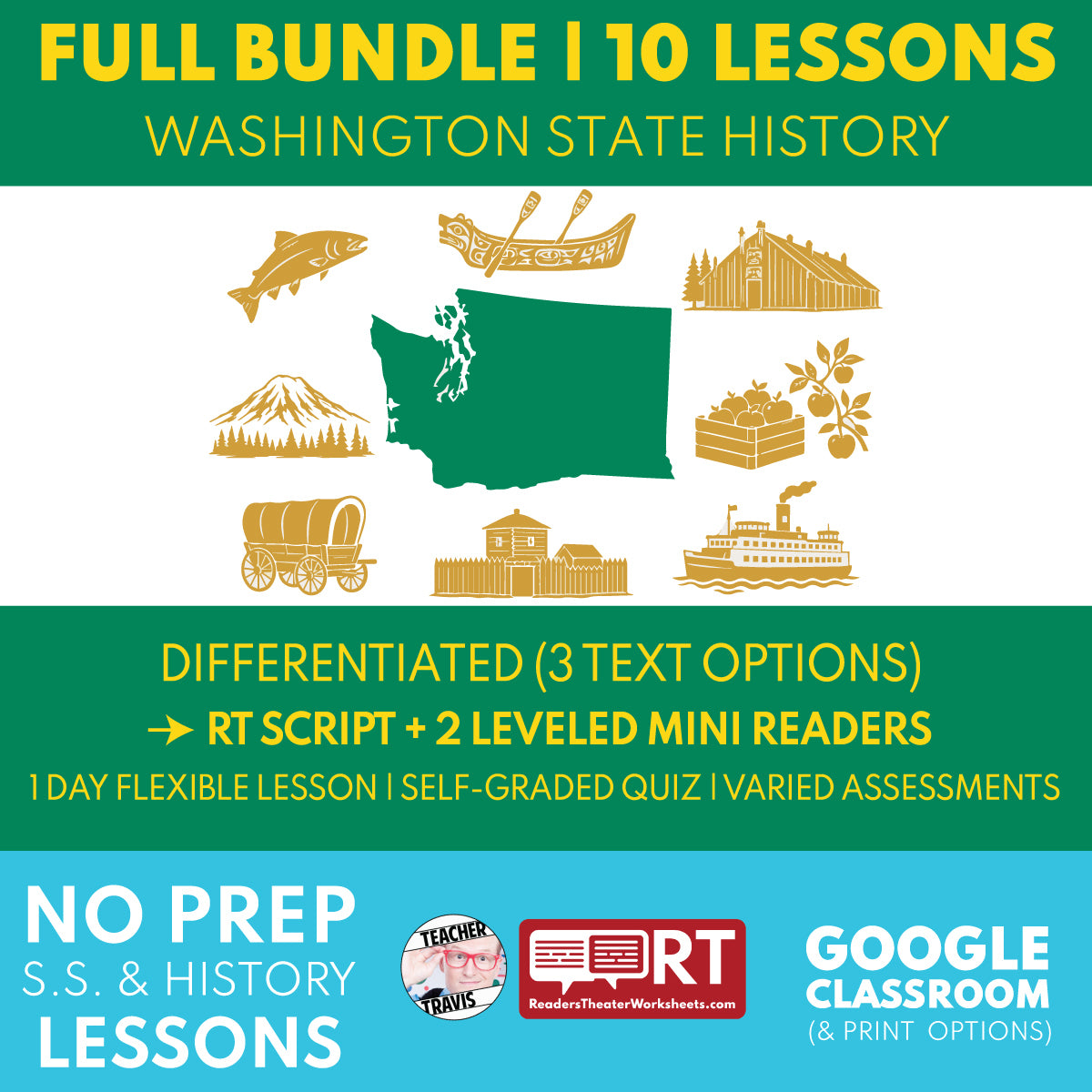
Bring Washington State History to life with a complete Grade 4 Reader's Theater and differentiated Mini Reader bundle covering geography, Tribal sovereignty, Indigenous trade networks, Lewis and Clark at the lower Columbia, Fort Vancouver, treaties, statehood, industrial growth, Japanese American incarceration, treaty fishing rights, and modern salmon co-management.

This ten-script mini unit gives students three ways to access the same essential content in every lesson: an engaging Reader's Theater script for oral fluency and discussion, an Original Mini Reader for independent reading, and an Accessible Mini Reader for mixed-level classes, multilingual learners, intervention, homework, or faster one-day use. Buy the complete set to save 35% compared with purchasing the paid lessons individually.

Try the format free: Download Mountains, Rivers, and Rain Shadows at no cost before purchasing the complete bundle.

10 Complete Washington State History Lessons

  1. 1. Mountains, Rivers, and Rain Shadows — Washington geography, climate, regions, resources, and transportation.
  2. 2. Since Time Immemorial — Tribal sovereignty, living governments, homelands, jurisdiction, and consultation.
  3. 3. Canoes, Salmon, and Cedar — Indigenous waterways, seasonal rounds, cedar technology, salmon, Celilo, and exchange.
  4. 4. At the Mouth of the Columbia — Lower Columbia Native communities, the Corps of Discovery, maps, journals, trade, and source limits.
  5. 5. Fort Vancouver Crossroads — Fort Vancouver, Hudson's Bay Company trade, labor, the Columbia River, and colonial change.
  6. 6. Promises on Paper — Treaty of Medicine Creek, homelands, cession, reservations, treaty rights, and federal obligations.
  7. 7. Territory to Statehood — Washington Territory, the 1889 Constitution, statehood, voting rights, and unfinished democracy.
  8. 8. Tracks to the Sound — Railroads, Puget Sound ports, workers, immigration, exclusion, industry, and the Klondike era.
  9. 9. Taken from Bainbridge — Japanese American incarceration, Bainbridge Island, civil liberties, removal, return, and redress.
  10. 10. The Salmon Case — Treaty fishing rights, Billy Frank Jr., the Boldt Decision, co-management, and salmon habitat.

Perfect For

  • Washington State History units and Grade 4 social studies
  • Mixed reading levels in grades 3–5
  • Reader's Theater, Mini Readers, oral fluency, and content-area literacy
  • Whole-class lessons, small groups, sub plans, review, intervention, and enrichment
  • Teachers who want a connected Washington-history sequence with printable and editable digital materials

Flexible Classroom Use

  • Use Reader's Theater scripts for whole-class reading, small-group performance, oral fluency, and evidence-based discussion.
  • Use Original or Accessible Mini Readers for independent reading, homework, centers, intervention, multilingual-learner support, or differentiated groups.
  • Assign digitally or print only the student sections needed for the day's lesson.
  • Use vocabulary, comprehension questions, challenge questions, quizzes, and evidence extensions for assessment, review, and deeper historical thinking.
  • Teach the full sequence as a Washington State History mini unit or select lessons to match local pacing.

Differentiation Built Into Every Lesson

  • Reader's Theater roles with varied reading loads and complexity
  • Original Mini Reader for on-level and advanced independent reading
  • Accessible Mini Reader preserving the same assessed facts with shorter sentences and clearer structure
  • Printable and editable options for flexible assignment
  • Shared vocabulary and assessments across all three reading paths

What Each Lesson Includes

Student Text Options

  • Reader's Theater Script with 12 differentiated roles
  • Original Mini Reader
  • Accessible Mini Reader

Assessment Materials

  • Vocabulary in context
  • 10 two-part comprehension questions
  • 5 two-part challenge questions
  • 20-question multiple-choice quiz
  • Self-grading Google Forms quiz support

Teacher Materials

  • Teacher Guide with Washington social studies/STI connections and CCSS literacy support
  • Answer keys and discussion prompts
  • Primary-source or evidence extension
  • Printable and editable classroom files

Skills Addressed

  • Reading comprehension across differentiated texts
  • Oral fluency and collaborative reading
  • Map skills, regions, routes, and geographic reasoning
  • Chronology, cause and effect, and change over time
  • Historical source analysis and evidence-based claims
  • Comparing perspectives and recognizing evidence limits
  • Government, sovereignty, rights, economics, labor, and informed participation
  • Vocabulary development, discussion, and written response

Standards Connections

The lessons connect to Washington Grade 4 Social Studies across history, geography, civics, economics, inquiry, source analysis, chronology, cause and effect, human-environment interaction, Tribal sovereignty, treaties, and government-to-government relationships. The set also supports CCSS Grade 4 literacy through informational reading, evidence use, vocabulary, fluency, collaborative discussion, and written response; Product 10 explicitly identifies RI.4.1, RI.4.2, RI.4.3, RI.4.4, RI.4.8, SL.4.1, SL.4.4, and RF.4.4.

Text Summary

Students begin with Washington's mountains, rivers, regions, and rain shadows, then study Tribal sovereignty and Indigenous trade networks before moving through the lower Columbia encounter, Fort Vancouver, Medicine Creek treaty history, territory and statehood, rail and industrial growth, Japanese American incarceration, and the Boldt Decision.

Across the bundle, students learn that Washington history is shaped by geography, living Tribal Nations, government decisions, treaties, migration, trade, labor, transportation, rights, conflict, evidence, environmental change, and communities responding to continuing challenges.

View full details