Readers Theater Worksheets
Washington State History | Tracks to the Sound RT Script and Mini Readers | Grades 3-5
Washington State History | Tracks to the Sound RT Script and Mini Readers | Grades 3-5
Couldn't load pickup availability
Classroom Use at a Glance
A Washington railroad and industry lesson for grades 3–5 with Puget Sound ports, workers, Chinese exclusion, timber, Klondike trade, differentiated texts, and assessments.
Classroom Uses Whole Class, Small Groups, Fluency Practice, Content-Area Reading, Discussion, Assessment, Review view all
- Whole Class
- Small Groups
- Fluency Practice
- Content-Area Reading
- Discussion
- Assessment
- Review
Included Reader’s Theater Script, Original Mini Reader, Accessible Mini Reader, Teacher Guide, Student Worksheet, Answer Key, Quiz, Google Forms Quiz, Vocabulary, Discussion Questions, Challenge Questions, Primary Source Extension view all
- Reader’s Theater Script
- Original Mini Reader
- Accessible Mini Reader
- Teacher Guide
- Student Worksheet
- Answer Key
- Quiz
- Google Forms Quiz
- Vocabulary
- Discussion Questions
- Challenge Questions
- Primary Source Extension
Format PDF, DOCX, Google Forms, ZIP Download, Printable, Editable view all
- DOCX
- Google Forms
- ZIP Download
- Printable
- Editable
Differentiation Accessible Version, Original Version, Mixed Reading Levels, ELL Support, Struggling Readers, Vocabulary Support, Small-Group Support view all
- Accessible Version
- Original Version
- Mixed Reading Levels
- ELL Support
- Struggling Readers
- Vocabulary Support
- Small-Group Support
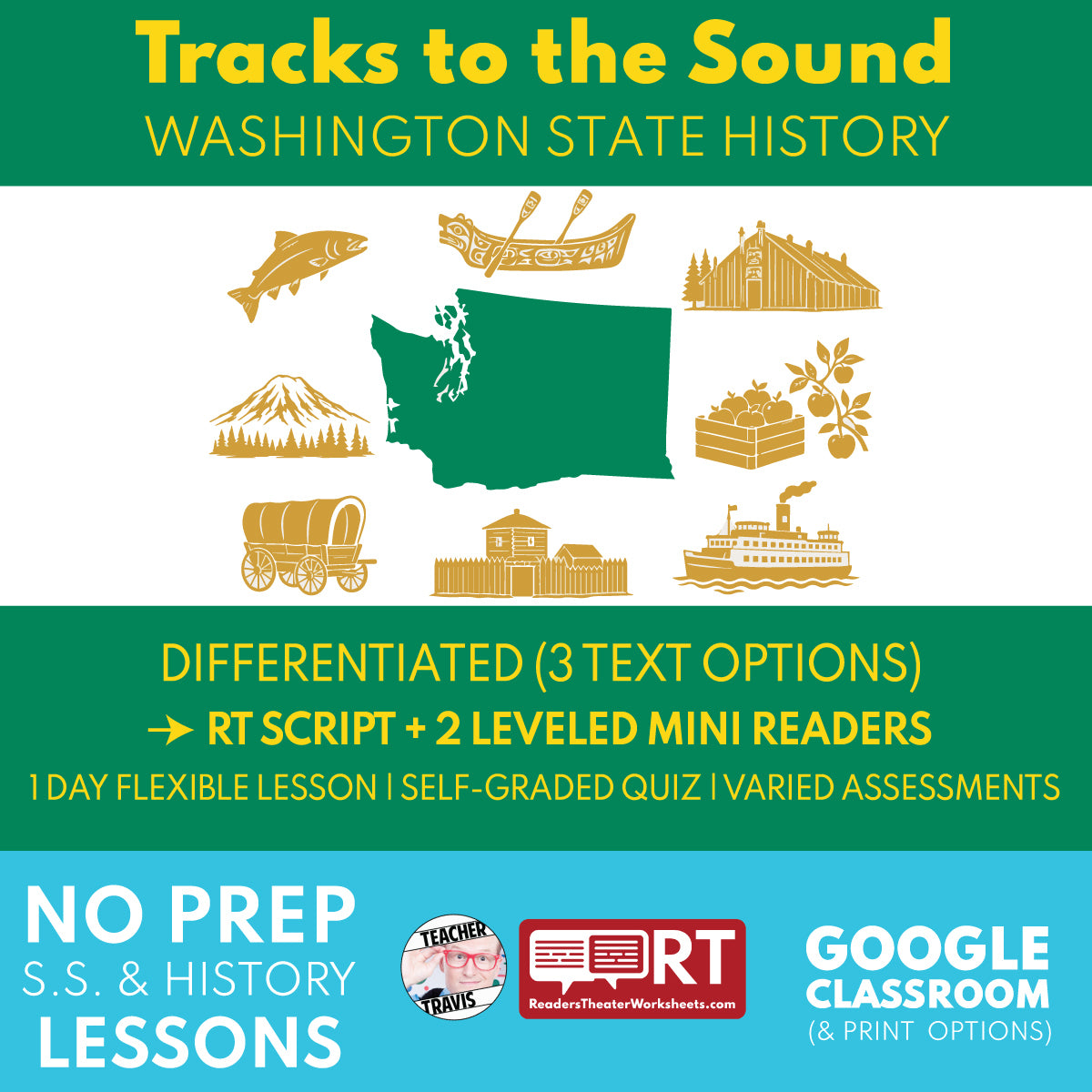
Trace Washington's late-1800s industrial growth through a Puget Sound freight shipment bound for a Klondike steamship. Students follow cargo backward and forward to uncover the workers, communities, environmental changes, and conflicts missing from a company route record.
Students connect railroads with farms, forests, mines, mills, towns, ports, workers, and markets. They compare railroad promotion with labor and community records, examine Chinese contribution beside exclusion, connect industrial development to Native homelands and environmental change, and explain why opportunity and conflict grew together.
Part 8 of the 10-script Washington State History bundle. Save 35% with the complete Washington State History Mini Unit Bundle.
Classroom Use
- Grade 4 Washington State History and grades 3–5 content-area literacy
- Whole-class Reader's Theater and oral fluency
- Small groups, sub plans, review, intervention, enrichment, and independent work
- Printable and editable digital use with shared questions across all three student texts
Standards Alignment
- Supports CCSS Grade 4 literacy connections through informational reading, vocabulary in context, evidence-based discussion, oral fluency, and written response.
- Washington Grade 4 Social Studies connections include E1.4.1, E2.4.1-4, E4.4.1-3, G1.4.1-2, G2.4.1-2, H1.4.1-3, H2.4.1-3, H3.4.1-4, H4.4.1-4, and C/SSS inquiry strands.
- The Teacher Guide identifies the lesson-specific Washington standards applications and evidence-based learning tasks.
Perfect For
- Washington State History units
- Grade 4 social studies and mixed grades 3–5 groups
- Reader's Theater, Mini Readers, and content-area literacy
- No-prep sub plans, review days, centers, and intervention
Flexible Differentiation
- Reader's Theater Script for oral reading, performance, fluency, and discussion
- Original Mini Reader for independent reading, homework, centers, or students ready for more detail
- Accessible Mini Reader preserving the same assessed core with shorter, clearer reading
- Shared vocabulary, questions, challenge questions, and quiz across all three reading paths
Skills Addressed
- Economic cause and effect
- Route and transportation analysis
- Labor and community history
- Source comparison
- Multi-cause historical reasoning
- Reading fluency, discussion, and writing
What's Included
- Reader's Theater Script with 12 differentiated roles
- Original Mini Reader
- Accessible Mini Reader
- 10 vocabulary terms in context
- 10 two-part comprehension questions
- 5 two-part challenge questions
- 20-question multiple-choice quiz and answer key
- Self-grading Google Forms quiz support
- Teacher Guide with Washington standards connections, discussion prompts, and source/evidence extension
- Printable and editable classroom files
Complete Washington State History Series
- 1. Mountains, Rivers, and Rain Shadows — Washington geography, climate, regions, resources, and transportation.
- 2. Since Time Immemorial — Tribal sovereignty, living governments, homelands, jurisdiction, and consultation.
- 3. Canoes, Salmon, and Cedar — Indigenous waterways, seasonal rounds, cedar technology, salmon, Celilo, and exchange.
- 4. At the Mouth of the Columbia — Lower Columbia Native communities, the Corps of Discovery, maps, journals, trade, and source limits.
- 5. Fort Vancouver Crossroads — Fort Vancouver, Hudson's Bay Company trade, labor, the Columbia River, and colonial change.
- 6. Promises on Paper — Treaty of Medicine Creek, homelands, cession, reservations, treaty rights, and federal obligations.
- 7. Territory to Statehood — Washington Territory, the 1889 Constitution, statehood, voting rights, and unfinished democracy.
- 8. Tracks to the Sound — Railroads, Puget Sound ports, workers, immigration, exclusion, industry, and the Klondike era.
- 9. Taken from Bainbridge — Japanese American incarceration, Bainbridge Island, civil liberties, removal, return, and redress.
- 10. The Salmon Case — Treaty fishing rights, Billy Frank Jr., the Boldt Decision, co-management, and salmon habitat.
Text Summary
A July 1897 freight platform becomes the starting point for tracing rail, timber, mill, neighborhood, warehouse, dock, and Seattle outfitting connections. The finished route record supports a multi-cause explanation of Washington growth rather than a railroad-only success story.
Share