
Skip to product information
1 of 1

Reader's Theater Worksheets

Wisconsin State History Mini Unit Bundle RT Script Mini Readers Grades 3-5

Wisconsin State History Mini Unit Bundle RT Script Mini Readers Grades 3-5

Regular price $17.50 USD
Regular price $27.00 USD Sale price $17.50 USD
Sale Sold out
Digital Instant Download

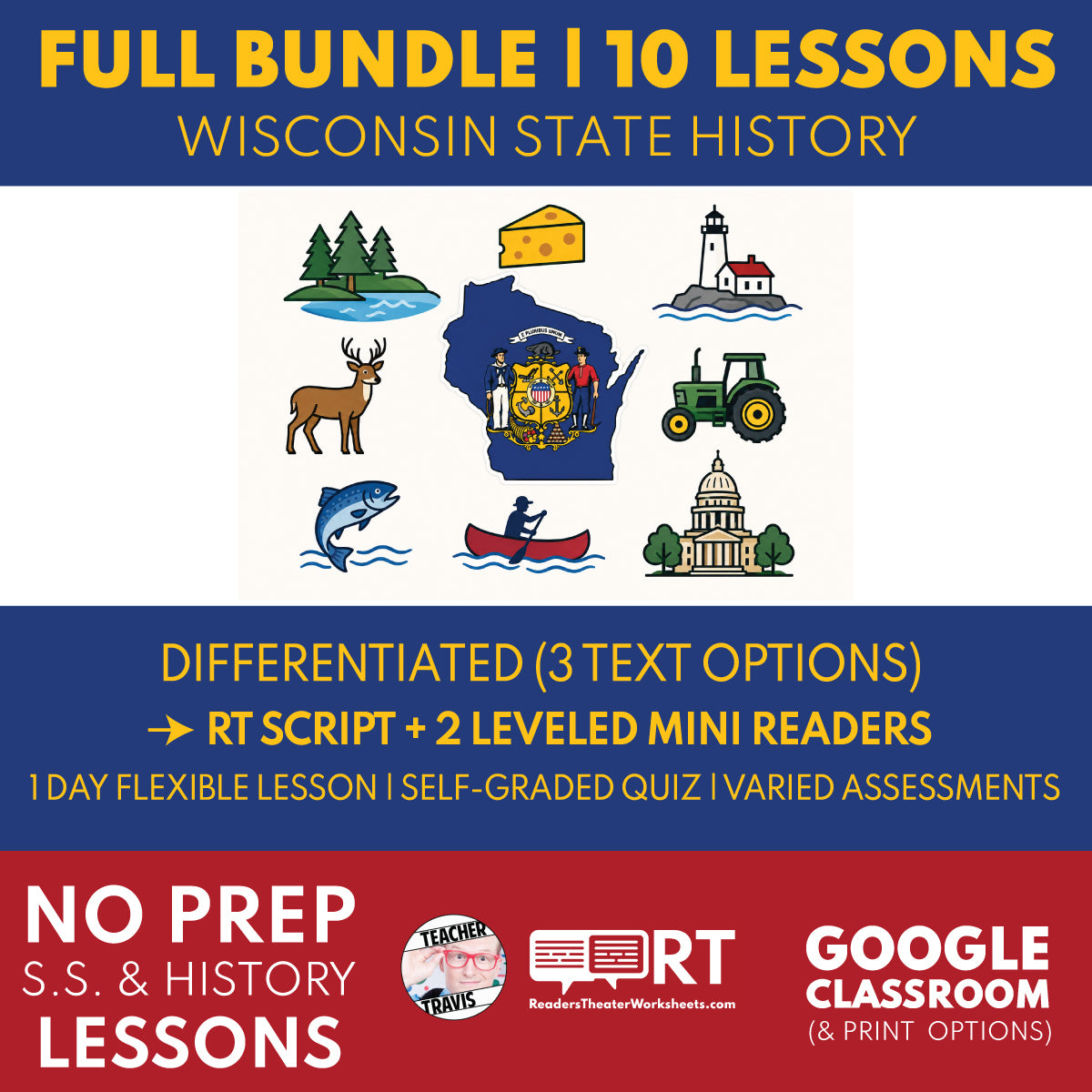
Bring Wisconsin State History to life with a complete Grade 4-focused Reader’s Theater and differentiated Mini Reader bundle for grades 3–5. The ten-lesson sequence connects Wisconsin geography, Tribal Nations and sovereignty, Great Lakes trade, changing political claims, statehood, economic change, migration and Hmong community history, freedom seeking and the Civil War, labor and Progressive reform, treaty rights, and Wisconsin today.

Each lesson gives students three coordinated ways to access the same essential content: a narrative Reader’s Theater for oral fluency and discussion, an Original Mini Reader for independent or shared Grade 4 reading, and an Accessible Mini Reader with supported Grade 3 language for mixed-level classes.

Try the format free: Use Lesson 1, Great Lakes, Mississippi River, and Wisconsin Geography, at no cost before purchasing the complete lesson set.

10 Complete Wisconsin State History Lessons

  1. 1. Great Lakes, Mississippi River, and Wisconsin Geography — Wisconsin geography, watersheds, major waterways, physical regions, the Driftless Area, resources, transportation, and community patterns.
  2. 2. Wisconsin Tribal Nations and Sovereignty Today — Wisconsin Tribal Nations, sovereignty, Tribal government, treaties, Nation-specific histories, continuity, citizenship, and government services today.
  3. 3. Canoes, Furs, and Great Lakes Trade — Native trade networks, birchbark canoe technology, the Fox-Wisconsin corridor, portage, fur-trade supply chains, Green Bay, La Pointe, and Prairie du Chien.
  4. 4. French, British, and American Wisconsin — French exploration and trade, British claims after 1763, U.S. claims after 1783, Prairie du Chien and the War of 1812, Native diplomacy, and the gradual growth of U.S. authority.
  5. 5. Territory to Statehood — Wisconsin Territory, Belmont, Madison, the 1838 boundary change, the enabling act, constitutional conventions, voter rejection and approval, and statehood in 1848.
  6. 6. Lead, Lumber, Wheat, and Dairy — lead mining, northern logging, wheat farming, dairy expansion, environmental change, transportation, markets, creameries, and the Babcock butterfat test.
  7. 7. German, Scandinavian, Polish, Hmong, and Other Wisconsin Communities — immigration and internal migration, German, Scandinavian, Polish, Black, Hmong, and other Wisconsin communities, refugee resettlement, community building, discrimination, civic life, and Act 266.
  8. 8. Freedom Seeking and Wisconsin in the Civil War — Joshua Glover, the Fugitive Slave Act, Wisconsin resistance, Ableman v. Booth, Milton House evidence, Union service, Camp Randall, the home front, emancipation, and unequal freedom.
  9. 9. Factories, Labor, and Progressive Wisconsin — industrial Milwaukee, factory work, labor organizing, the 1886 eight-hour movement, Bay View, Progressive reform, Robert M. La Follette, the Wisconsin Idea, worker protections, and women’s suffrage.
  10. 10. Treaty Rights, Natural Resources, Tribal Government, and Wisconsin Today — 1837 and 1842 Ojibwe treaties, reserved rights, ceded territory, the Voigt decision, GLIFWC, Tribal regulation, Wisconsin DNR science, safe harvest, spring spearfishing, and Menominee restoration.

Perfect For

  • Wisconsin State History and Grade 4 social studies
  • Mixed reading levels across grades 3–5
  • Reader’s Theater, Mini Readers, fluency, and content-area literacy
  • Wisconsin Act 31 and Act 266 connections within a broader state-history sequence
  • Whole-class lessons, small groups, sub plans, review, intervention, and enrichment

Flexible Classroom Use

  • Use the Reader’s Theater scripts for whole-class reading, small-group performance, oral fluency, and discussion.
  • Use the Original or Accessible Mini Readers for independent reading, homework, centers, intervention, ELL support, or differentiated groups.
  • Use the worksheets, challenge questions, quizzes, and source extensions for assessment, review, and deeper historical thinking.
  • Teach the sequence in order or select individual lessons to match your pacing guide.

What Each Lesson Includes

Student Text Options

  • 10-scene Reader’s Theater Script with differentiated speaking roles
  • Original Mini Reader
  • Accessible Mini Reader

Assessment Materials

  • Vocabulary in context
  • 10 two-part comprehension questions
  • 5 two-part challenge questions
  • 20-question multiple-choice quiz
  • Self-graded Google Forms quiz workflow

Teacher Materials

  • Teacher Guide and Wisconsin standards alignment
  • Answer keys and discussion prompts
  • Source-based teacher references and extensions
  • Printable and editable files

Skills Addressed

  • Reading fluency and collaborative reading
  • Comprehension and vocabulary in context
  • Map skills and geographic reasoning
  • Chronology, cause and effect, continuity, and change over time
  • Historical evidence and perspective taking
  • Government, citizenship, economics, and natural-resource decision making
  • Discussion and evidence-based written response

Standards Support

The individual Teacher Guides identify applicable Wisconsin Social Studies standards across history, geography, economics, political science, and inquiry. CCSS literacy connections are supported through reading, oral fluency, vocabulary, discussion, text evidence, and written response.

Text Summary

Students move through a connected Wisconsin story beginning with land and water, then following Tribal governments, trade, political change, statehood, work and economic transitions, migration, rights and conflict, reform, treaty rights, conservation, and present-day government decisions. The sequence is designed so fourth graders learn the facts through memorable narratives while still practicing careful historical thinking.

View full details