
Readers Theater Worksheets
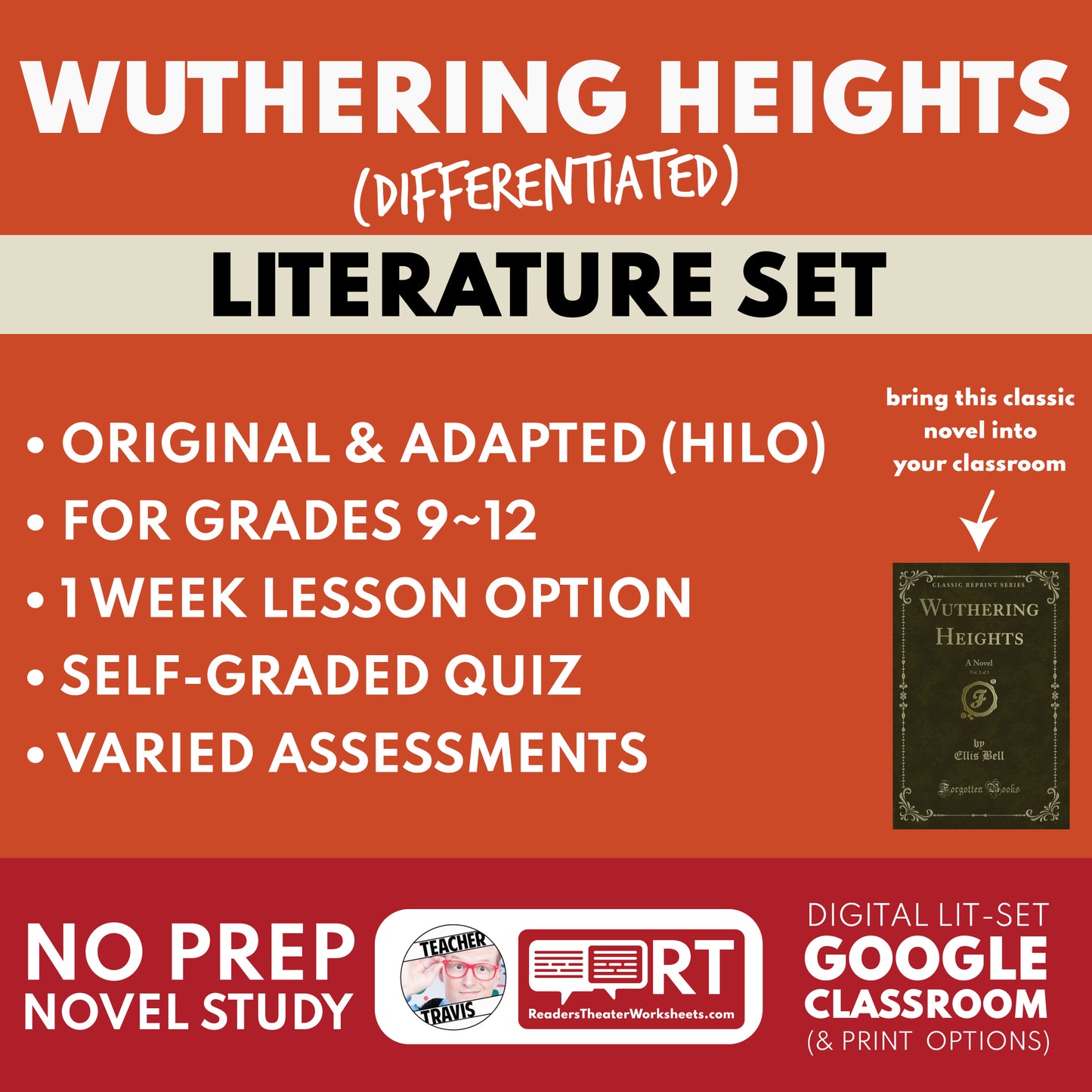
Wuthering Heights Differentiated Novel Study | ELA Literature | Brontë Lit Set for High School
Wuthering Heights Differentiated Novel Study | ELA Literature | Brontë Lit Set for High School
Couldn't load pickup availability
Classroom Use at a Glance
A no-prep differentiated literature study guide for high school students with reading, comprehension, vocabulary, discussion, writing, quiz, and teacher support materials. Designed for mixed-ability ELA classes, close reading, literature discussion, assessment, and differentiated instruction.
Classroom Uses Whole Class, Small Groups, Close Reading, Discussion, Assessment, Review, Enrichment, Sub Plan view all
- Whole Class
- Small Groups
- Close Reading
- Discussion
- Assessment
- Review
- Enrichment
- Sub Plan
Included Original Text, Teacher Guide, Student Worksheet, Answer Key, Quiz, Google Forms Quiz, Vocabulary, Discussion Questions, Challenge Questions, Writing Prompt view all
- Original Text
- Teacher Guide
- Student Worksheet
- Answer Key
- Quiz
- Google Forms Quiz
- Vocabulary
- Discussion Questions
- Challenge Questions
- Writing Prompt
Format PDF, DOCX, Google Docs, Google Forms, Printable, Editable view all
- DOCX
- Google Docs
- Google Forms
- Printable
- Editable
Differentiation Leveled Version, Original Version, Mixed Reading Levels, Vocabulary Support, Short Sections view all
- Leveled Version
- Original Version
- Mixed Reading Levels
- Vocabulary Support
- Short Sections
Problem: Many teachers want to teach classic literature, but the full text can be too long for limited class time—and a single reading level rarely fits an entire room. Planning separate materials for mixed abilities is time-consuming, and it often results in uneven pacing, inconsistent discussions, and students who fall behind before the most important turning points.
Here’s the solution: This differentiated Wuthering Heights by Brontë novel study / digital lit-set solves that problem by giving you two complete reading tracks that stay perfectly aligned: the full original text of Wuthering Heights plus a streamlined, five-part adapted version that preserves the core plot, relationships, and moral complexity.
Every discussion question, multiple-choice exit quiz, short-answer item, and challenge question works for both tracks—so you can teach one cohesive novel unit while students read at the level that best supports comprehension and confidence.
Perfect for Grades 9–10 ELA classrooms, small groups, intervention + extension pairing, and literature circles where students need the same high-quality themes and assessments without being forced into the same text difficulty. Skills supported include evidence-based analysis, character motivation and change, theme development, point of view and narration, and structured discussion and writing aligned to CCSS expectations.
Quick Guide for Teachers:
Adapted-Only Track (Fastest: 5-Day Model)
- Best for Grades 9–10 classes that need a manageable, one-week novel experience.
- Day 1–5: Students read one adapted part per day and use the matching Main Ideas & Themes Discussion Questions and self-grading multiple-choice quiz.
- End the week with the Final Worksheet (Vocabulary Words, Short Answer Questions, and Challenge Questions).
- This track keeps lessons tight, predictable, and complete in five days.
Original-Only Track (Longer: Multi-Day Per Section)
- Ideal for stronger readers or classes ready for original language and sentence structure.
- Students read the original chapters aligned to each adapted Part
- Use the same Discussion Questions, MC exit quizzes, and Final Worksheet; all items are text-accurate for both versions.
- Vocabulary Words (10) are usable for both tracks, because each word appears in both the adapted text and the corresponding original chapters.
- This track preserves the full descriptive style and classic voice while giving you ready-made, age-appropriate assessments.
Dual-Track Differentiation (Mixed Readers, Flexible Timelines)
- Lets your entire class study the same plot, scenes, and themes at the same time—even when some students need the adapted text and others handle the full novel.
- Assign adapted Part 1 to students who need a shorter, clearer text and original corresponding chapters to students reading the full text; repeat this pattern through Parts 2–5 (timing will depend on your classroom's reading level)
- Give original-text students multiple days per section while adapted-text students reread key scenes, complete vocabulary tasks, and tackle discussion questions in pairs or small groups.
- All assessments are usable for both tracks: Discussion Questions, MC Exit Quizzes for each Part, and the Final Worksheet (Vocabulary, Short Answer, and Challenge Questions).
What’s the Tradeoff of Using the Adapted Version?
Pros:
- Reduces the novel to a fraction of its original length, fitting neatly into a one-week unit.
- Well suited for shorter attention spans and developing readers in Grades 9-10
- Preserves core narrative elements, characters, and themes
- Far better than skipping the book entirely due to time limits or reading-level concerns.
- Works for whole-class read-alouds, small-group novel studies, independent reading, or focused close-reading lessons.
Cons:
- Omits some original language, side scenes, and descriptive passages for brevity, so students do not see every nuance of the original author's style.
- Leaves fewer opportunities for deep line-by-line stylistic analysis than a full-length, multi-week novel study.
Bottom Line:
If you have the time and budget, nothing beats the feel of a real paperback in every student’s hands. But when time, copies, and reading levels are real constraints, a digital literature set like this—adapted text + original text mapping + shared assessments—lets you bring this classic novel into your classroom instead of leaving it on the “maybe someday” shelf. If you were to buy traditional paperbacks at about $7 per book for 30 students, that is a $210 investment. This digital lit-set gives you a reusable, print-friendly alternative you can adapt for many years and multiple groups.
Try a digital lit set first for FREE! (It's just like this one)
[FREE DOWNLOAD] The Great Gatsby Differentiated Novel Study | Lit Set
This product includes a zip file consisting of:
NOTE: All files are editable and include (PDF, DOCX, PPTX, Google Docs/Slides/Forms)
Full Original Text: ~116,000 words | 7.7 Flesch-Kincaid GL
- Lexile Ranges: ~900L - 1150L | CEFR ~B1+ / B2-
- Great for advanced readers (or 8–10 graders), extension groups, longer-term novel studies.
-
BONUS: Free Access to the text on our LEVELED-LIT CLASSICS Library Platform.
Adapted Version Text: ~13,200 words | 6.2 Flesch-Kincaid GL
- Lexile Ranges: ~750L - 950L | CEFR ~B1-
- Great for Grades 8–10 readers who need a shorter text with the same language level—faster pacing, clearer structure, and more manageable reading volume while keeping rigorous vocabulary and syntax.
- *Both versions tell the same story, allowing students to participate in shared discussions even when reading different texts.
Student Final Worksheet/Quizzes (PPTX, Google Slides/Forms)
- 10 Vocabulary Words
- 10 Short Answer Recall/Comprehension
- 5 Challenge Questions (synthesis, analysis, themes, real life connection)
- 5 Multiple Choice Quizzes (20 Questions) (1 per part)
Teacher’s Guide & Answer Key
- 5 Sets of Daily Discussion Questions (1 per part)
- 5 Sets of Self-Graded Exit Quizzes (1 per part, 20Qs each)
- Answer Keys for Vocab, Short Answer, and Challenge Questions
- Key Figures & Places reference sheets to help students track characters and settings
Student Final Worksheet/Quizzes (PPTX, Google Slides/Forms)
- 10 Vocabulary Words
- 10 Short Answer Recall/Comprehension
- 5 Challenge Questions (synthesis, analysis, themes, real life connection)
- 5 Multiple Choice Quizzes (20 Questions) (1 per part)
- Teacher’s Guide & Answer Key
- 5 Sets of Daily Discussion Questions (1 per part)
- 5 Sets of Self-Graded Exit Quizzes (1 per part, 20Qs each)
- Answer Keys for Vocab, Short Answer, and Challenge Questions
- Key Figures & Places reference sheets to help students track characters and settings
Adapted Version Summary (and source chapters)
Part 1 – A Stranger at the Heights
Adapted from: Chapters I–VII of the original novel.
Lockwood arrives at Thrushcross Grange and becomes fixated on his unsettling landlord and the hostile household at Wuthering Heights. A night of snow, locked doors, and a terrifying dream pushes him to seek answers. Nelly Dean begins the past: Heathcliff is brought into the Earnshaw family, rivalry grows, and Catherine’s time at the Grange reshapes her sense of status and belonging.
Part 2 – The Choice That Breaks the House
Adapted from: Chapters VIII–XIV of the original novel.
Catherine confesses that marrying Edgar will make her “great,” even as she describes Heathcliff as inseparable from her inner self. Heathcliff’s departure and return intensify the conflict, and Hindley’s decline creates vulnerability inside Wuthering Heights. Isabella’s romantic pursuit becomes a pathway into cruelty, while Catherine’s illness exposes how pride and love collide until the household’s fragile balance breaks.
Part 3 – Death, Marriage, and the Machinery of Revenge
Adapted from: Chapters XV–XVIII of the original novel.
A secret meeting between Catherine and Heathcliff erupts into confrontation when Edgar returns, and Catherine’s final days are dominated by unresolved truth and emotional extremes. After her death, grief turns into obsession rather than peace. Heathcliff transforms loss into a strategy of control, damaging lives through leverage and positioning the next generation inside the structure of his revenge.
Part 4 – The Next Generation in the Trap
Adapted from: Chapters XIX–XXVI of the original novel.
Young Cathy’s curiosity draws her toward the forbidden world of Wuthering Heights, where she meets Hareton and the fragile Linton. Secret letters deepen the connection, and guilt-driven pressure makes Cathy feel responsible for Linton’s suffering. As Edgar weakens, Heathcliff uses time, confinement, and fear to turn Cathy’s compassion into coercion and force the outcome he wants.
Part 5 – What the Dead Refuse to Release
Adapted from: Chapters XXVII–XXXIV of the original novel.
After the forced marriage, Cathy’s life is reshaped by legal consequence and household control, and she is left to endure the Heights’ daily oppression. When Linton dies, Cathy’s anger slowly shifts into a new relationship with Hareton built through learning and mutual respect. Heathcliff’s revenge loses its taste; his fixation turns inward toward Catherine’s memory, and the household’s power structure weakens as the next generation chooses repair.
Frequently Asked Questions About the Adapted Wuthering Heights Novel Study
Q: Can I use the adapted text with reluctant or below-level readers without changing the unit?
A: Yes. The adapted version is 13,200 words at a Flesch-Kincaid Grade Level of 6.2, designed to preserve the novel’s core plot and conflicts while reducing reading load. Students reading the adapted track can complete the same quizzes, discussions, short answers, and Challenge Questions with the same Part pacing.
Q: Is this unit aligned to CCSS for the intended grade band?
A: Yes. The tasks and prompts directly support RL.9–10 standards (text evidence, theme, character, structure, point of view), SL.9–10 discussion expectations, and L.9–10 vocabulary/word-meaning work, with CCRA anchors aligned to evidence-based reading, analysis, and academic discussion.
Q: How does the differentiation work if students read different versions?
A: Both tracks follow the same five-part structure with a clear chapter map (Parts 1–5). You assign the same Part number and the same assessment set to everyone, and students answer using evidence from their version (Adapted Part or Original Chapters). This keeps pacing unified while letting you match text difficulty to student need.
This is a complete, no-prep Wuthering Heights unit built for true dual-track teaching—one cohesive plan, two aligned texts, and one assessment system that works for both.
Get this in a Bundle of 10 Digital Lit Sets & SAVE 40%
CCSS Standards
Reading Literature: CCSS RL.9-10.1, CCSS RL.9-10.2, CCSS RL.9-10.3, CCSS RL.9-10.4, CCSS RL.9-10.5, CCSS RL.9-10.6, CCSS RL.11-12.1, CCSS RL.11-12.2, CCSS RL.11-12.3, CCSS RL.11-12.4, CCSS RL.11-12.5, CCSS RL.11-12.6
Speaking & Listening: CCSS SL.9-10.1, CCSS SL.11-12.1
Language: CCSS L.9-10.4, CCSS L.11-12.4
Anchor Standards: CCRA.R.1, CCRA.R.2, CCRA.R.3, CCRA.R.4, CCRA.R.5, CCRA.R.6, CCRA.W.1, CCRA.W.2, CCRA.W.9, CCRA.SL.1, CCRA.L.1, CCRA.L.2, CCRA.L.4
Share