
Readers Theater Worksheets
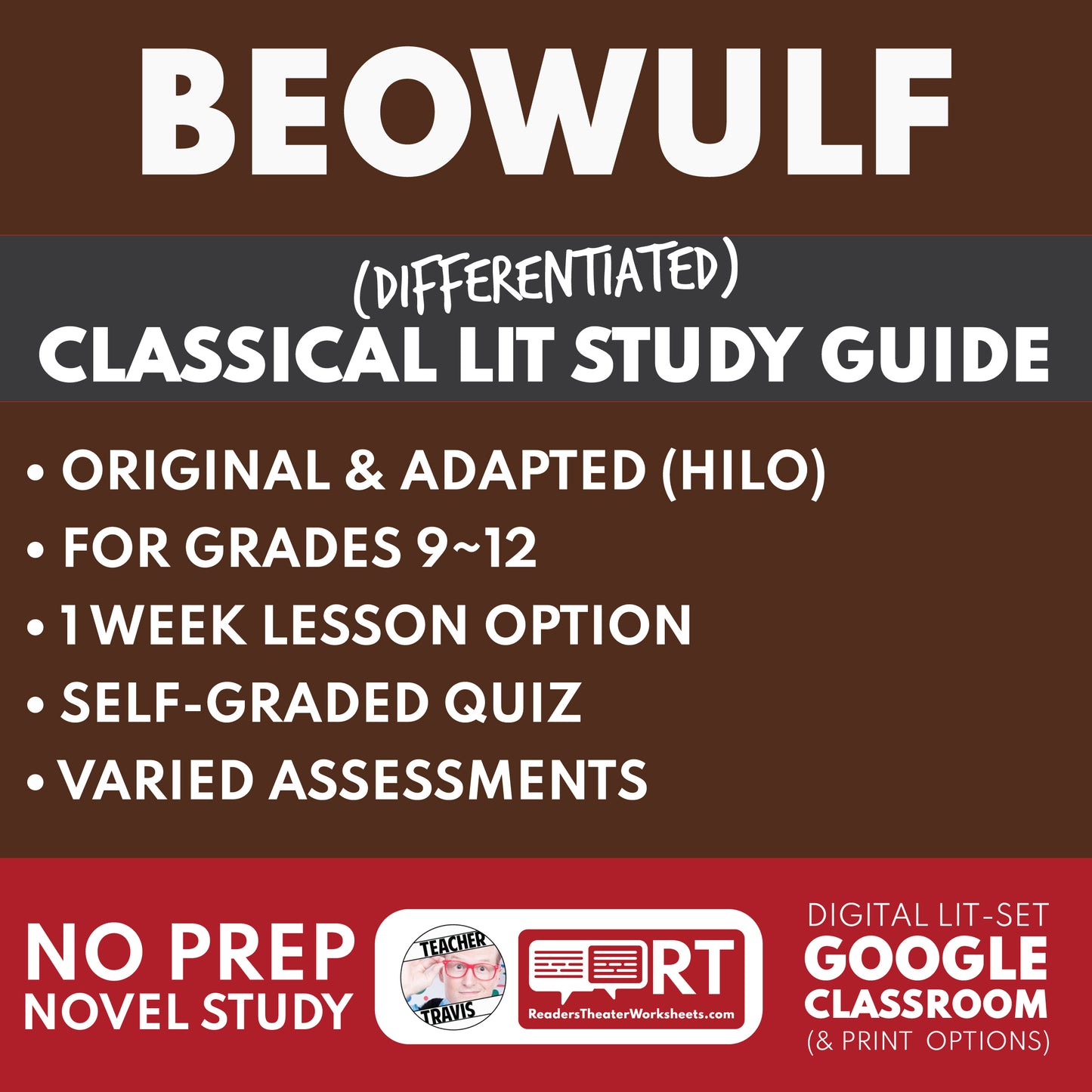
Beowulf by Anonymous Differentiated Classical Lit Study Guide for Grades 9 to 12
Beowulf by Anonymous Differentiated Classical Lit Study Guide for Grades 9 to 12
Couldn't load pickup availability
Classroom Use at a Glance
A differentiated study guide for Grades 9 to 12 built to support mixed reading levels, close reading, vocabulary, comprehension, discussion, written response, quizzes, and teacher-led literature instruction.
Classroom Uses Whole Class, Close Reading, Discussion, Assessment, Review, Enrichment, Intervention, Homework, Sub Plan view all
- Whole Class
- Close Reading
- Discussion
- Assessment
- Review
- Enrichment
- Intervention
- Homework
- Sub Plan
Included Original Text, Leveled Text, Teacher Guide, Student Worksheet, Answer Key, Quiz, Google Forms Quiz, Vocabulary, Discussion Questions, Writing Prompt view all
- Original Text
- Leveled Text
- Teacher Guide
- Student Worksheet
- Answer Key
- Quiz
- Google Forms Quiz
- Vocabulary
- Discussion Questions
- Writing Prompt
Format PDF, DOCX, Google Docs, Google Forms, Printable, Editable, ZIP Download view all
- DOCX
- Google Docs
- Google Forms
- Printable
- Editable
- ZIP Download
Differentiation Original Version, Leveled Version, Mixed Reading Levels, Struggling Readers, Advanced Readers, Vocabulary Support, Short Sections view all
- Original Version
- Leveled Version
- Mixed Reading Levels
- Struggling Readers
- Advanced Readers
- Vocabulary Support
- Short Sections
Problem: Many teachers want to teach Beowulf, but the full text can be time-consuming and uneven for mixed reading levels. Planning discussions, quizzes, and written responses that still feel rigorous—without spending hours rewriting materials—can become the barrier that keeps this classic off the syllabus.
Here’s the solution: This differentiated novel study solves that problem with a complete dual-track lit-set: it includes the complete original text plus a full adapted five-part version designed for faster pacing and clearer access. Every Part in the adaptation is mapped directly to the original chapters (Parts 1–5), so your class stays synchronized even when students read different versions. Every discussion question, multiple-choice exit quiz, short-answer item, and challenge question works for both tracks—students can answer using either the original chapters or the matching adapted Part without missing required information.
Perfect for Grades 9–12 classrooms focused on close reading, theme development, character and leadership analysis, evidence-based discussion, and academic vocabulary growth—without sacrificing the richness of a foundational epic.
How can I be sure this resource will meet my needs?
1) Open in full view the first preview thumbnail and read the Adapted Version sample to see if the text is suitable for your classroom's reading level.
2) Also, you can test drive these similar digital lit sets for FREE!
- [FREE DOWNLOAD] The Great Gatsby Differentiated Novel Study
- [FREE DOWNLOAD] Adapted Peter Pan Differentiated Novel Study
- [FREE DOWNLOAD] The Wonderful Wizard of Oz Adapted Version
- [FREE DOWNLOAD] A Christmas Carol Adapted Version
SAVE 40% and get the Full Bundle: 8 Differentiated Ancient & Medieval Western Literature Study Guides
Quick Guide for Teachers:
Adapted-Only Track (Fastest: 5-Day Model)
- Best for Grades 9–12 classes that need a manageable, one-week novel experience.
- Day 1–5: Students read one adapted part per day and use the matching Main Ideas & Themes Discussion Questions and self-grading multiple-choice quiz.
- End the week with the Final Worksheet (Vocabulary Words, Short Answer Questions, and Challenge Questions).
- This track keeps lessons tight, predictable, and complete in five days.
Original-Only Track (Longer: Multi-Day Per Section)
- Ideal for stronger readers or classes ready for original language and sentence structure.
- Students read the original chapters/books aligned to each adapted Part.
- Use the same Discussion Questions, MC exit quizzes, and Final Worksheet; all items are text-accurate for both versions.
- Vocabulary Words (10) are usable for both tracks, because each word appears in both the adapted text and the corresponding original chapters/books.
- This track preserves the full descriptive style and classic voice while giving you ready-made, age-appropriate assessments.
Dual-Track Differentiation (Mixed Readers, Flexible Timelines)
- Lets your entire class study the same plot, scenes, and themes at the same time—even when some students need the adapted text and others handle the full novel.
- Assign adapted Part 1 to students who need a shorter, clearer text and original corresponding chapters/books to students reading the full text; repeat this pattern through Parts 2–5 (timing will depend on your classroom's reading level).
- Give original-text students multiple days per section while adapted-text students reread key scenes, complete vocabulary tasks, and tackle discussion questions in pairs or small groups.
- All assessments are usable for both tracks: Discussion Questions, MC Exit Quizzes for each Part, and the Final Worksheet (Vocabulary, Short Answer, and Challenge Questions).
This product includes a zip file consisting of:
NOTE: All files are editable and include (PDF, DOCX, PPTX, Google Docs/Slides/Forms).
Full Original Text: ~23,000 words | 9.8 Flesch-Kincaid GL
- Lexile Ranges: ~1050L - 1335L | CEFR ~B1 - C1
- Great for advanced readers, extension groups, honors classes, and longer-term novel studies.
- BONUS: Free Access to the text on our LEVELED-LIT CLASSICS Library Platform.
Adapted Version Text: ~12,800 words | 6.0 Flesch-Kincaid GL
- Lexile Ranges: ~925L - 1070L | CEFR ~B1
- Divided into 5 parts for easy daily reading sessions.
- *Both versions tell the same story, allowing students to participate in shared discussions even when reading different texts.
Student Final Worksheet/Quizzes (PPTX, Google Slides/Forms)
- 10 Vocabulary Words
- 10 Short Answer Recall/Comprehension
- 5 Challenge Questions (synthesis, analysis, themes, real life connection)
- 5 Multiple Choice Quizzes (20 Questions) (1 per part)
Teacher’s Guide & Answer Key
- 5 Sets of Daily Discussion Questions (1 per part)
- 5 Sets of Self-Graded Exit Quizzes (1 per part, 20Qs each)
- Answer Keys for Vocab, Short Answer, and Challenge Questions
- Key Figures & Places reference sheets to help students track characters and settings
What’s the Tradeoff of Using the Adapted Version?
Pros:
- Reduces the text to a fraction of its original length, fitting neatly into a one-week unit.
- Well suited for shorter attention spans and developing readers in Grades 9–10.
- Preserves core narrative elements, characters, and themes.
- Far better than skipping the book entirely due to time limits or reading-level concerns.
- Works for whole-class read-alouds, small-group novel studies, independent reading, or focused close-reading lessons.
Cons:
- Omits some original language, side scenes, and descriptive passages for brevity, so students do not see every nuance of the original author's style.
- Leaves fewer opportunities for deep line-by-line stylistic analysis than a full-length, multi-week novel study.
Bottom Line:
If you have the time and budget, nothing beats the feel of a real paperback in every student’s hands. But when time, copies, and reading levels are real constraints, a digital literature set like this—adapted text + original text mapping + shared assessments—lets you bring this classic into your classroom instead of leaving it on the “maybe someday” shelf. If you were to buy traditional paperbacks at about $7 per book for 30 students, that is a $210 investment. This digital lit-set gives you a reusable, print-friendly alternative you can adapt for many years and multiple groups.
Adapted Version Summary (and source chapters)
Part 1 – The Hall That Draws the Shadow
Adapted from: Chapters PRELUDE, I–V of the original text.
The Danish royal world is established through origin, succession, and the social gravity of the hall. A monstrous night-terror turns that symbol of order into a site of helplessness and fear. Beowulf hears of the crisis, crosses the sea, and arrives ready for the court’s judgment and the night’s test.
Part 2 – The Grip in Heorot
Adapted from: Chapters VI–XIV of the original text.
Beowulf is welcomed into Hrothgar’s court but forced to define his honor under scrutiny and challenge. He commits to meeting the monster directly, turning the confrontation into a contest of strength and will. Grendel is broken and driven off, and the victory is publicly affirmed through praise, reward, and restored order.
Part 3 – Vengeance from the Mere
Adapted from: Chapters XV–XXIV of the original text.
Retaliation follows celebration when Grendel’s mother strikes back, proving that terror can return even after triumph. Beowulf pursues the feud into a hostile mere where reputation and trusted weapons offer no guarantees. He returns with visible proof that the immediate cycle of terror has been closed—at a cost.
Part 4 – Counsel, Homecoming, and Reputation
Adapted from: Chapters XXV–XXVIII of the original text.
Hrothgar warns Beowulf about pride, power, and the limits of strength, reframing heroism as moral discipline rather than mere victory. Beowulf departs and recounts the Danish events at home, turning deeds into political meaning and foresight. Honor becomes something a community must interpret and carry forward.
Part 5 – The Dragon and the Last Accounting
Adapted from: Chapters XXIX–XLI of the original text.
A theft from a dragon’s hoard ignites national catastrophe, and Beowulf chooses final confrontation despite age and foreboding. The battle exposes the fragility of loyalty as most followers fail when fear is closest. Victory arrives with Beowulf’s death, and the poem ends by measuring legacy against the uncertainty his absence unleashes.
Frequently Asked Questions
Can I use the adapted text for reluctant or below-level readers without changing the assessments?
Yes. The adapted version is ~12,800 words at a 6.0 Flesch-Kincaid Grade Level, and each Part maps directly to the original chapters—so students on either track complete the same questions using the text they read.
Is this unit aligned to Common Core for the stated grade band?
Yes. The tasks align to RL standards for evidence-based analysis and theme/central idea development, SL discussion expectations, and L academic vocabulary work suitable for Grades 9–12.
How does differentiation work if some students read the original and others read the adapted version?
The unit is designed as dual-track: each adapted Part corresponds to a specific original chapter range, so the class stays synchronized while reading load and language complexity vary by student needs—without requiring separate assessments.
CCSS Standards
Reading Literature: CCSS RL.9-10.1, CCSS RL.9-10.2, CCSS RL.9-10.3, CCSS RL.9-10.4, CCSS RL.9-10.5, CCSS RL.9-10.6, CCSS RL.11-12.1, CCSS RL.11-12.2, CCSS RL.11-12.3, CCSS RL.11-12.4, CCSS RL.11-12.5, CCSS RL.11-12.6
Speaking & Listening: CCSS SL.9-10.1, CCSS SL.11-12.1
Language: CCSS L.9-10.4, CCSS L.11-12.4
Anchor Standards: CCRA.R.1, CCRA.R.2, CCRA.R.3, CCRA.R.4, CCRA.R.5, CCRA.R.6, CCRA.W.1, CCRA.W.2, CCRA.W.9, CCRA.SL.1, CCRA.L.1, CCRA.L.2, CCRA.L.4
Share