Dynamic History
Electoral College Geography | Dynamic History Module | Grades 9-12
Electoral College Geography | Dynamic History Module | Grades 9-12
Couldn't load pickup availability
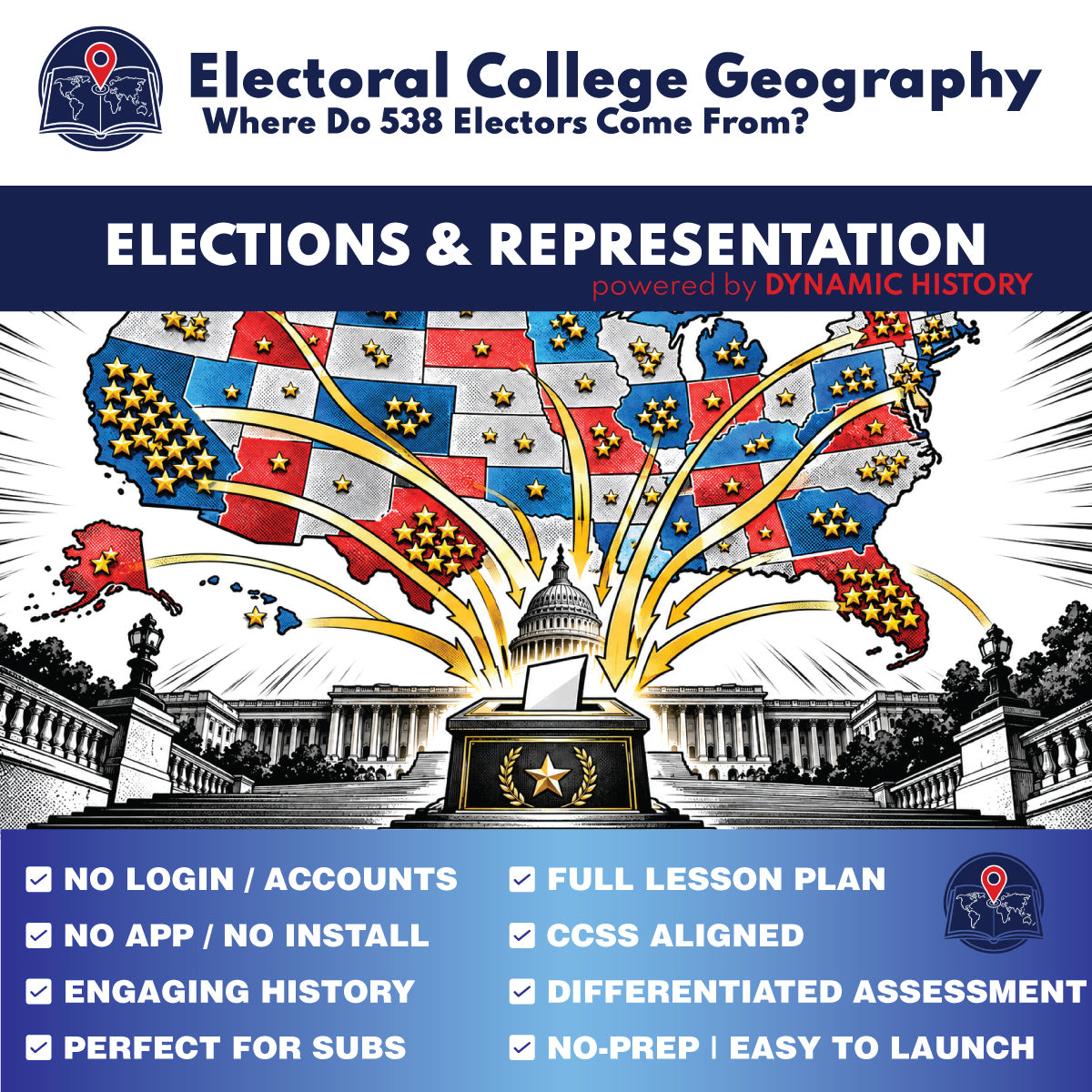
Turn the number 538 into a geographic and constitutional investigation. In this two-day Dynamic History module, students trace where presidential electors come from, why every state has at least three, how Washington, D.C. receives electors, where electors actually meet, and why Maine and Nebraska divide part of their electoral votes by congressional district.
Students distinguish electors from members of Congress, Certificates of Ascertainment from Certificates of Vote, and the Electoral College process from the common misconception that all electors meet in one national place. The final stop connects census-based House reapportionment to changing state elector totals while the national total remains 538.
What students investigate
- Article II and the House-seats-plus-two-senators elector formula
- Why every state has at least three presidential electors
- Washington, D.C., the 23rd Amendment, and its three electors
- Certificates of Ascertainment and Certificates of Vote
- Where presidential electors meet and how their votes travel to Congress
- Maine's congressional-district and at-large elector system
- Nebraska's congressional-district and at-large elector system
- Why 435 House seats + 100 Senate seats + 3 D.C. electors produces a total of 538
State and local classroom connection
The module is designed for nationwide government classes, with additional local search relevance for Maine and Nebraska because their district-based elector allocation is a full case study rather than a passing example.
What's included
- Two-day guided Dynamic History investigation with six mapped stops
- Teacher Guide and Answer Key with Day 1 and Day 2 pacing
- Standard and Accessible reading levels inside the interactive module
- Editable digital student worksheet generated in Google Slides
- Printable student worksheet generated in Google Slides
- Self-graded Google Forms quiz and MC print quiz
- Assessment bank with 5 vocabulary terms, 4 two-part short-answer questions, 2 two-part challenge questions, and 15 multiple-choice questions
Flexible classroom use
- Teach the core investigation across two 45-50 minute class periods
- Project the interactive module for whole-class instruction or use individual/shared student devices
- Use the digital worksheet for typed responses or the printable worksheet for paper-based response work
- Use selected written questions for homework, review, or a short check for understanding
- Use the complete assessment as a separate assessment period when desired
Skills addressed
- Using constitutional formulas and maps to explain electoral-vote totals
- Distinguishing states, Washington D.C., and congressional districts within the Electoral College process
- Comparing official election certificates and explaining what each document records
- Comparing statewide and congressional-district allocation methods without evaluating which is preferable
- Tracing how census reapportionment can change state shares while the national total remains fixed
Standards alignment
CCSS History/Social Studies literacy connections documented in the Teacher Guide include RH.9-10.1, RH.9-10.2, RH.9-10.7, RH.9-10.9 and corresponding RH.11-12 standards where appropriate. Written extensions may also support WHST.9-10.1, WHST.9-10.2, WHST.9-10.9 and corresponding WHST.11-12 standards.
Digital and print student outputs
The shared Google Classroom folder contains the editable digital worksheet, printable worksheet, self-graded quiz, MC print quiz, and source Teacher Guide generated from the final assessment bank. The Standard and Accessible reading levels are available inside the interactive Dynamic History module.
Share