
Dynamic History
Elections and Representation Dynamic History Bundle - 6 Modules (G9-12)
Elections and Representation Dynamic History Bundle - 6 Modules (G9-12)
Couldn't load pickup availability
Classroom Use at a Glance
Classroom Uses Whole Class, Small Groups, Content-Area Reading, Discussion, Assessment, Review, Homework, Sub Plan view all
- Whole Class
- Small Groups
- Content-Area Reading
- Discussion
- Assessment
- Review
- Homework
- Sub Plan
Included Teacher Guide, Student Worksheet, Answer Key, Quiz, Google Forms Quiz, Vocabulary, Discussion Questions, Challenge Questions view all
- Teacher Guide
- Student Worksheet
- Answer Key
- Quiz
- Google Forms Quiz
- Vocabulary
- Discussion Questions
- Challenge Questions
Format PDF, DOCX, Google Docs, Google Slides, Google Forms, PowerPoint, ZIP Download, Printable, Editable view all
- DOCX
- Google Docs
- Google Slides
- Google Forms
- PowerPoint
- ZIP Download
- Printable
- Editable
Differentiation Accessible Version, Mixed Reading Levels, ELL Support, Struggling Readers, Vocabulary Support, Small-Group Support view all
- Accessible Version
- Mixed Reading Levels
- ELL Support
- Struggling Readers
- Vocabulary Support
- Small-Group Support
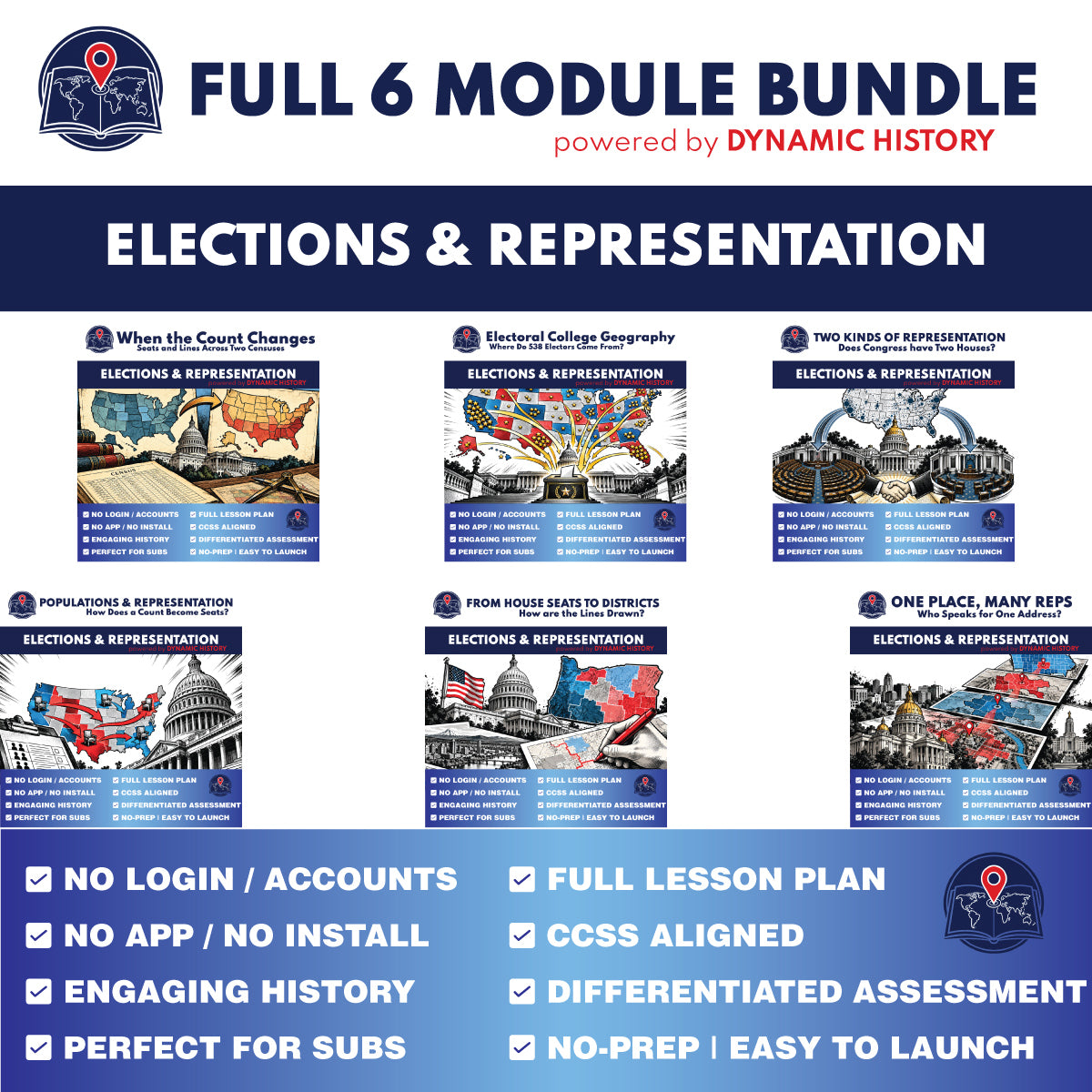
Teach elections and representation as a connected system rather than as isolated vocabulary. This grades 9-12 Dynamic History bundle includes six complete two-day investigations that move from the census and House apportionment to congressional districts, overlapping layers of representation, the two-house structure of Congress, Electoral College geography, and changes across census cycles.
Students use mapped evidence, constitutional text, court decisions, census and apportionment data, district maps, official records, and state case studies to explain how representation is counted, assigned, organized, and revised. The six modules can be taught as a sequence or assigned independently inside a U.S. Government, Civics, U.S. History, or Social Studies course.
Included modules
- Population and Representation — census, House apportionment, the fixed 435-seat House, and changes after the 2020 census.
- From House Seats to Districts — Oregon case study on gaining a House seat, equal-population rules, and drawing six congressional districts.
- One Place, Many Representatives — Des Moines and Iowa case study on city, county, state legislative, U.S. House, and statewide representation, with a Nebraska comparison.
- Two Kinds of Representation — constitutional development of population-based House representation and equal state representation in the Senate.
- Electoral College Geography — the 538-elector system, the 23rd Amendment, elector meetings and certificates, and Maine and Nebraska allocation rules.
- When the Count Changes — Montana, West Virginia, and Iowa case studies showing how reapportionment and redistricting can produce different kinds of change.
What students investigate
- How the census connects population counts to representation in the U.S. House
- How apportionment differs from redistricting
- Why congressional districts within a state must contain nearly equal populations
- How one location can sit inside city, county, state legislative, congressional, and statewide layers of representation
- Why the House and Senate use different rules of representation
- How presidential electors are allocated and where the national total of 538 comes from
- How reapportionment can move House seats among states while redistricting changes lines within states
- What maps, population data, constitutional text, court decisions, and official records can and cannot establish
State-based case studies
The series teaches national government concepts through detailed state examples, including Oregon, Iowa, Nebraska, Maine, Montana, and West Virginia. These case studies make the national rules concrete while also giving teachers in those states locally grounded examples for government, civics, and state-history connections.
What's included
- 6 Dynamic History modules for grades 9-12
- 36 mapped investigation stops across the full series
- 144 guided module questions across the six investigations
- 6 Teacher Guides and Answer Keys with suggested two-day pacing
- Standard and Accessible reading levels inside each interactive module
- Editable digital and printable student worksheet support
- Self-graded Google Forms quiz support and multiple-choice quiz materials
- Assessment banks totaling 30 vocabulary terms, 24 two-part short-answer questions, 12 two-part challenge questions, and 90 multiple-choice questions
Flexible classroom use
- Teach one module as a focused two-day civics investigation
- Teach all six in sequence for approximately 12 class periods of core investigation time
- Use selected modules alongside an existing government or U.S. history curriculum
- Project the interactive experience for whole-class instruction or use student devices
- Use the assessment banks for homework, review, source synthesis, or separate assessment periods
Standards alignment
The Teacher Guides document CCSS History/Social Studies literacy connections including RH.9-10.1, RH.9-10.2, RH.9-10.7, RH.9-10.9 and corresponding RH.11-12 standards. Written extensions may also support WHST.9-10 and WHST.11-12 evidence-based writing standards identified in the individual guides.
Share