Dynamic History
One Place, Many Representatives | Dynamic History Module | Grades 9-12
One Place, Many Representatives | Dynamic History Module | Grades 9-12
Couldn't load pickup availability
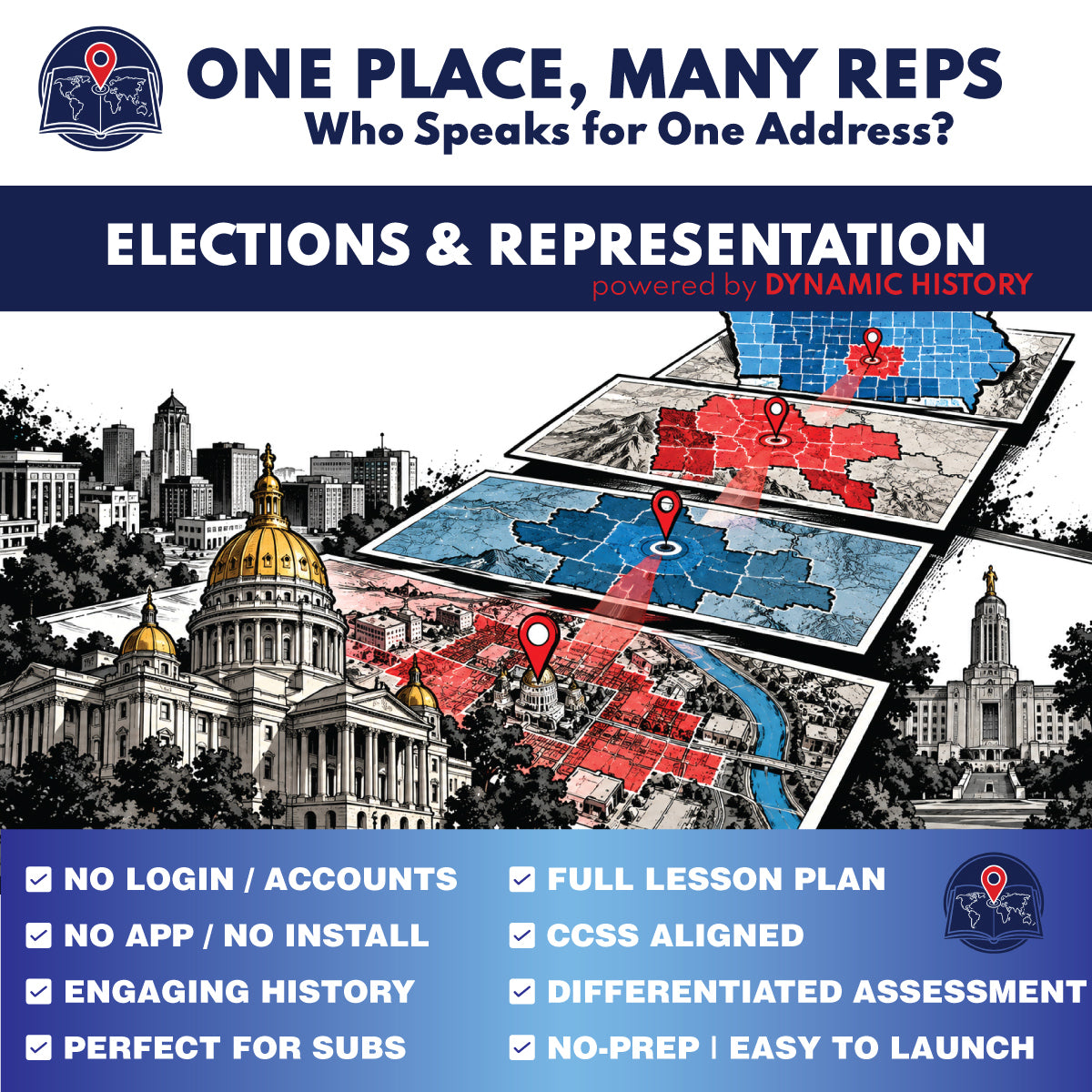
Show students how one address can sit inside several layers of government at once. This two-day Dynamic History investigation begins at the Iowa State Capitol in Des Moines and moves outward through city, county, Iowa House, Iowa Senate, U.S. House, and statewide U.S. Senate representation.
Students compare at-large and ward representation, city and county boundaries, equal-population legislative districts, Iowa's nested House and Senate maps, and the larger scale of a congressional district. The final stop compares Iowa's bicameral legislature with Nebraska's one-house unicameral system.
What students investigate
- Des Moines city government, at-large council seats, and ward representation
- Polk County government and the difference between city and county boundaries
- Iowa House District 33 and equal-population state legislative districts
- Iowa Senate District 17 and the nesting of House Districts 33 and 34
- Iowa's statutory redistricting process and population-based district design
- Iowa's Third Congressional District and the scale of U.S. House representation
- Statewide U.S. Senate representation with two senators per state
- Nebraska's 49-member unicameral legislature and comparison with Iowa's bicameral system
State and local classroom connection
The lesson is nationally useful for teaching overlapping layers of government, but it also gives Iowa teachers a deeply local Des Moines-to-Congress case study and gives Nebraska teachers a direct comparison with the state's unicameral legislature.
What's included
- Two-day guided Dynamic History investigation with six mapped stops
- Teacher Guide and Answer Key with Day 1 and Day 2 pacing
- Standard and Accessible reading levels inside the interactive module
- Editable digital student worksheet generated in Google Slides
- Printable student worksheet generated in Google Slides
- Self-graded Google Forms quiz and MC print quiz
- Assessment bank with 5 vocabulary terms, 4 two-part short-answer questions, 2 two-part challenge questions, and 15 multiple-choice questions
Flexible classroom use
- Teach the core investigation across two 45-50 minute class periods
- Project the interactive module for whole-class instruction or use individual/shared student devices
- Use the digital worksheet for typed responses or the printable worksheet for paper-based response work
- Use selected written questions for homework, review, or a short check for understanding
- Use the complete assessment as a separate assessment period when desired
Skills addressed
- Tracing overlapping layers of local, state, and federal representation
- Distinguishing at-large representation from ward or district representation
- Reading nested legislative and congressional district maps
- Comparing equal-population districts at different scales
- Comparing bicameral and unicameral state legislative structures
Standards alignment
CCSS History/Social Studies literacy connections documented in the Teacher Guide include RH.9-10.1, RH.9-10.2, RH.9-10.7, RH.9-10.9 and corresponding RH.11-12 standards where appropriate. Written extensions may also support WHST.9-10.1, WHST.9-10.2, WHST.9-10.9 and corresponding WHST.11-12 standards.
Digital and print student outputs
The shared Google Classroom folder contains the editable digital worksheet, printable worksheet, self-graded quiz, MC print quiz, and source Teacher Guide generated from the final assessment bank. The Standard and Accessible reading levels are available inside the interactive Dynamic History module.
Share