Dynamic History
Two Kinds of Representation | Dynamic History Module | Grades 9-12
Two Kinds of Representation | Dynamic History Module | Grades 9-12
Couldn't load pickup availability
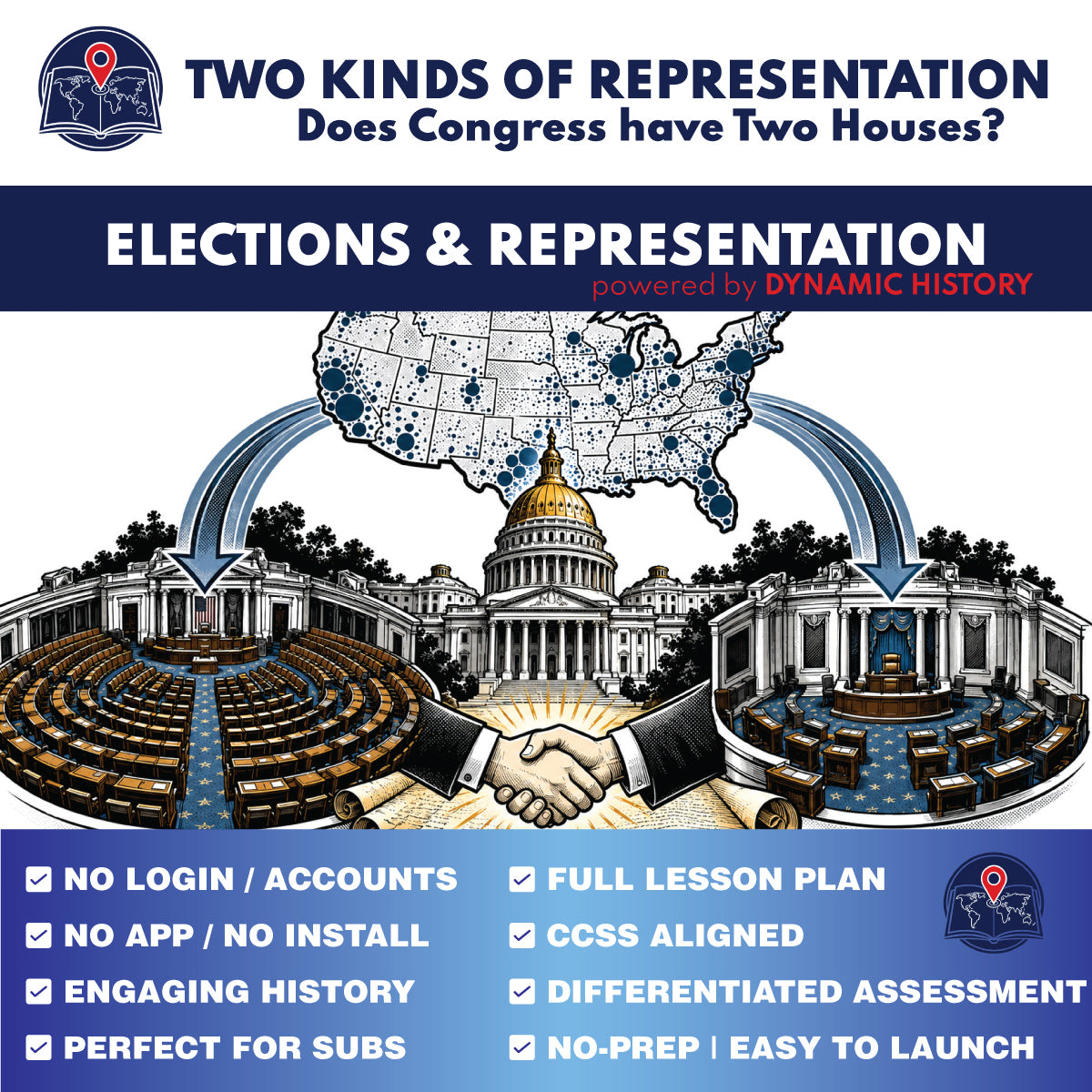
Help students understand why Congress has two chambers that use different representation rules. This two-day Dynamic History investigation begins with one-state-one-vote under the Articles of Confederation and follows the debate through the Virginia Plan, New Jersey Plan, Connecticut Compromise, modern Congress, and the 17th Amendment.
Students compare the interests behind population-based and equal-state representation, distinguish a one-house legislature from a two-house legislature, and keep the July 12 three-fifths decision separate from the July 16 representation compromise. The final stop distinguishes how senators are represented from how senators are selected.
What students investigate
- One state, one vote under the Articles of Confederation
- The Virginia Plan and population-based representation in a bicameral legislature
- The New Jersey Plan and equal state voting in a unicameral legislature
- Large-state and small-state interests at the Constitutional Convention
- The July 12 three-fifths representation and taxation decision
- The Connecticut Compromise of July 16, 1787
- House representation by population and equal representation in the Senate today
- The 17th Amendment and the shift from legislative selection to direct election of senators
What's included
- Two-day guided Dynamic History investigation with six mapped stops
- Teacher Guide and Answer Key with Day 1 and Day 2 pacing
- Standard and Accessible reading levels inside the interactive module
- Editable digital student worksheet generated in Google Slides
- Printable student worksheet generated in Google Slides
- Self-graded Google Forms quiz and MC print quiz
- Assessment bank with 5 vocabulary terms, 4 two-part short-answer questions, 2 two-part challenge questions, and 15 multiple-choice questions
Flexible classroom use
- Teach the core investigation across two 45-50 minute class periods
- Project the interactive module for whole-class instruction or use individual/shared student devices
- Use the digital worksheet for typed responses or the printable worksheet for paper-based response work
- Use selected written questions for homework, review, or a short check for understanding
- Use the complete assessment as a separate assessment period when desired
Skills addressed
- Comparing competing constitutional plans and representation rules
- Tracing cause, conflict, compromise, and institutional design
- Distinguishing unicameral and bicameral legislatures
- Separating representation rules from the method used to select officeholders
- Using founding-era documents and modern maps to support historical explanations
Standards alignment
CCSS History/Social Studies literacy connections documented in the Teacher Guide include RH.9-10.1, RH.9-10.2, RH.9-10.7, RH.9-10.9 and corresponding RH.11-12 standards where appropriate. Written extensions may also support WHST.9-10.1, WHST.9-10.2, WHST.9-10.9 and corresponding WHST.11-12 standards.
Digital and print student outputs
The shared Google Classroom folder contains the editable digital worksheet, printable worksheet, self-graded quiz, MC print quiz, and source Teacher Guide generated from the final assessment bank. The Standard and Accessible reading levels are available inside the interactive Dynamic History module.
Share