
Readers Theater Worksheets
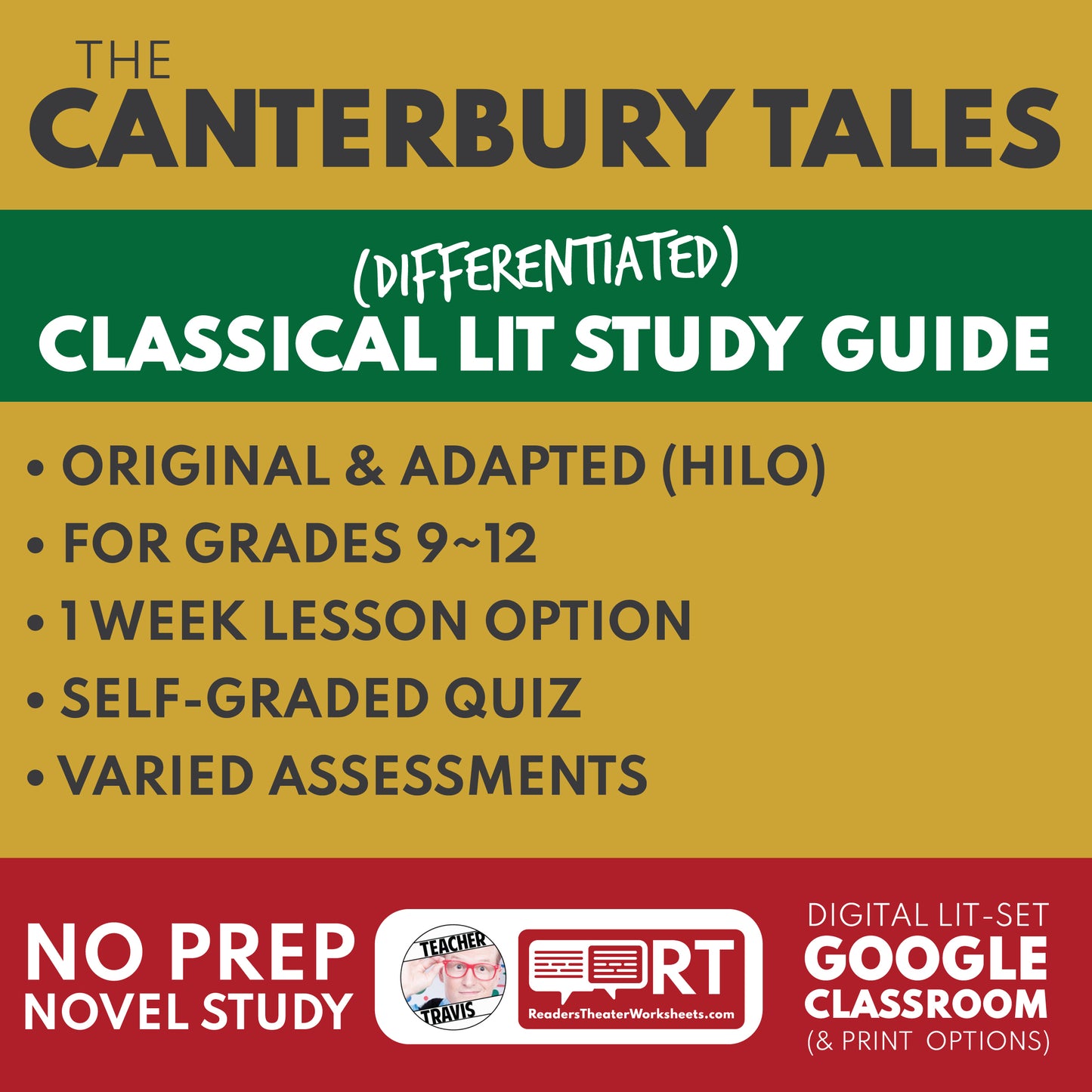
The Canterbury Tales by Geoffrey Chaucer Differentiated Classical Lit Study Guide for Grades 9 to 12
The Canterbury Tales by Geoffrey Chaucer Differentiated Classical Lit Study Guide for Grades 9 to 12
Couldn't load pickup availability
Classroom Use at a Glance
A differentiated literature study guide for grades 9–12 using The Canterbury Tales by Geoffrey Chaucer Differentiated Classical Lit Study Guide for Grades 9 to 12. Built to support mixed reading levels, close reading, vocabulary, discussion, assessment, and no-prep ELA instruction.
Classroom Uses Close Reading, Discussion, Assessment, Whole Class, Homework, Sub Plan view all
- Close Reading
- Discussion
- Assessment
- Whole Class
- Homework
- Sub Plan
Included Original Text, Leveled Text, Teacher Guide, Student Worksheet, Answer Key, Quiz, Google Forms Quiz, Vocabulary, Discussion Questions, Writing Prompt view all
- Original Text
- Leveled Text
- Teacher Guide
- Student Worksheet
- Answer Key
- Quiz
- Google Forms Quiz
- Vocabulary
- Discussion Questions
- Writing Prompt
Format PDF, DOCX, Google Docs, Google Forms, Online Library Access, Printable, Editable view all
- DOCX
- Google Docs
- Google Forms
- Online Library Access
- Printable
- Editable
Differentiation Original Version, Leveled Version, Mixed Reading Levels, Vocabulary Support, Struggling Readers, Advanced Readers view all
- Original Version
- Leveled Version
- Mixed Reading Levels
- Vocabulary Support
- Struggling Readers
- Advanced Readers
Problem: Teachers love teaching classic literature—but full-length texts can be time-consuming, uneven for mixed reading levels, and difficult to turn into consistently rigorous, text-dependent daily work without spending hours building materials.
Here’s the solution: This differentiated novel study solves that problem by giving you both reading tracks in one complete unit: the full original text of The Canterbury Tales plus a five-part adapted version built for classroom pacing and accessibility. Every part includes a clear chapter-to-part map, so students reading different versions can still complete the same assignments and participate in the same discussions. Every discussion question, multiple-choice exit quiz, short-answer item, and challenge question works for both tracks—so you can differentiate by reading load without differentiating your entire teaching plan.
Perfect for Grades 9–12 ELA classrooms focused on close reading, theme development, argument-based responses, narrative structure (frame + counter-tales), and evidence-based discussion—especially when you need one unit that can flex for on-level, advanced, and supported readers.
How can I be sure this resource will meet my needs?
1) Open in full view the first preview thumbnail and read the Adapted Version sample to see if the text is suitable for your classroom's reading level.
2) Also, you can test drive these similar digital lit sets for FREE!
- [FREE DOWNLOAD] The Great Gatsby Differentiated Novel Study
- [FREE DOWNLOAD] Adapted Peter Pan Differentiated Novel Study
- [FREE DOWNLOAD] The Wonderful Wizard of Oz Adapted Version
- [FREE DOWNLOAD] A Christmas Carol Adapted Version
SAVE 40% and get the Full Bundle: 8 Differentiated Ancient & Medieval Western Literature Study Guides
Quick Guide for Teachers:
Adapted-Only Track (Fastest: 5-Day Model)
- Best for Grades 9–12 classes that need a manageable, one-week novel experience.
- Day 1–5: Students read one adapted part per day and use the matching Main Ideas & Themes Discussion Questions and self-grading multiple-choice quiz.
- End the week with the Final Worksheet (Vocabulary Words, Short Answer Questions, and Challenge Questions).
- This track keeps lessons tight, predictable, and complete in five days.
Original-Only Track (Longer: Multi-Day Per Section)
- Ideal for stronger readers or classes ready for original language and sentence structure.
- Students read the original chapters/books aligned to each adapted Part.
- Use the same Discussion Questions, MC exit quizzes, and Final Worksheet; all items are text-accurate for both versions.
- Vocabulary Words (10) are usable for both tracks, because each word appears in both the adapted text and the corresponding original chapters/books.
- This track preserves the full descriptive style and classic voice while giving you ready-made, age-appropriate assessments.
Dual-Track Differentiation (Mixed Readers, Flexible Timelines)
- Lets your entire class study the same plot, scenes, and themes at the same time—even when some students need the adapted text and others handle the full novel.
- Assign adapted Part 1 to students who need a shorter, clearer text and original corresponding chapters/books to students reading the full text; repeat this pattern through Parts 2–5 (timing will depend on your classroom's reading level).
- Give original-text students multiple days per section while adapted-text students reread key scenes, complete vocabulary tasks, and tackle discussion questions in pairs or small groups.
- All assessments are usable for both tracks: Discussion Questions, MC Exit Quizzes for each Part, and the Final Worksheet (Vocabulary, Short Answer, and Challenge Questions).
This product includes a zip file consisting of:
NOTE: All files are editable and include (PDF, DOCX, PPTX, Google Docs/Slides/Forms).
Full Original Text: ~200,000 words | 10.0 Flesch-Kincaid GL
- Lexile Ranges: ~1050L - 1335L | CEFR ~C1–C2
- Great for advanced readers, extension groups, honors classes, and longer-term novel studies.
- BONUS: Free Access to the text on our LEVELED-LIT CLASSICS Library Platform.
Adapted Version Text: ~14,000 words | 8 Flesch-Kincaid GL
- Lexile Ranges: ~925L - 1185L | CEFR ~B2–C1
- Divided into 5 parts for easy daily reading sessions.
- *Both versions tell the same story, allowing students to participate in shared discussions even when reading different texts.
Student Final Worksheet/Quizzes (PPTX, Google Slides/Forms)
- 10 Vocabulary Words
- 10 Short Answer Recall/Comprehension
- 5 Challenge Questions (synthesis, analysis, themes, real life connection)
- 5 Multiple Choice Quizzes (20 Questions) (1 per part)
Teacher’s Guide & Answer Key
- 5 Sets of Daily Discussion Questions (1 per part)
- 5 Sets of Self-Graded Exit Quizzes (1 per part, 20Qs each)
- Answer Keys for Vocab, Short Answer, and Challenge Questions
- Key Figures & Places reference sheets to help students track characters and settings
What’s the Tradeoff of Using the Adapted Version?
Pros:
- Reduces the text to a fraction of its original length, fitting neatly into a one-week unit.
- Well suited for shorter attention spans and developing readers in Grades 9–10.
- Preserves core narrative elements, characters, and themes.
- Far better than skipping the book entirely due to time limits or reading-level concerns.
- Works for whole-class read-alouds, small-group novel studies, independent reading, or focused close-reading lessons.
Cons:
- Omits some original language, side scenes, and descriptive passages for brevity, so students do not see every nuance of the original author's style.
- Leaves fewer opportunities for deep line-by-line stylistic analysis than a full-length, multi-week novel study.
Bottom Line:
If you have the time and budget, nothing beats the feel of a real paperback in every student’s hands. But when time, copies, and reading levels are real constraints, a digital literature set like this—adapted text + original text mapping + shared assessments—lets you bring this classic into your classroom instead of leaving it on the “maybe someday” shelf. If you were to buy traditional paperbacks at about $7 per book for 30 students, that is a $210 investment. This digital lit-set gives you a reusable, print-friendly alternative you can adapt for many years and multiple groups.
Adapted Version Summary (and source chapters)
Part 1 – The Pilgrimage Begins and the Contest Turns Competitive
Adapted from: Group A (General Prologue through the Cook’s Tale fragment).
A diverse group of pilgrims is introduced through sharp portraits and immediate social friction. The Host launches a storytelling contest that turns the road into a stage for reputation and rivalry. Early tales establish the book’s signature pattern: “high” ideals collide with blunt realism, and storytellers answer one another with escalating boldness.
Part 2 – Law, Commerce, Piety, and a Forced Shift in Storytelling Mode
Adapted from: Group B (Man of Law through Monk).
This section foregrounds institutional pressures—law, trade, and religious identity—while testing innocence, justice, and public judgment. The group’s reactions shape what kinds of stories can be told, forcing shifts in tone and purpose. Darker reversals accumulate, emphasizing how quickly status and safety can collapse.
Part 3 – Moral Performance, Greed, Marriage Power, and Counter-Tales
Adapted from: End of Group B (Nun’s Priest) + Groups C–E (Physician, Pardoner, Wife of Bath, Friar & Summoner, Clerk).
Tales become open arguments about morality, credibility, and power. Stories of greed and persuasion expose the gap between moral speech and moral action. Marriage debates intensify into competing claims about sovereignty, obedience, and justice, pushing students toward evidence-based evaluation rather than simple “lesson” hunting.
Part 4 – Promises, Illusions, Sanctity, Fraud, and the Cost of Speech
Adapted from: Groups E–H (Merchant, Squire, Franklin, Second Nun, Canon’s Yeoman, Manciple).
Promises and contracts collide with desire, reputation, and fear of consequence. Imagination and “marvel” appear beside exposed fraud, especially where specialized knowledge becomes a weapon. The social risk of speech becomes clearer as stories reveal hidden motives and force public reckonings.
Part 5 – The Turn to Penitence and the Closing Texts
Adapted from: Group I (Parson + Retraction/closing materials).
The collection shifts from competitive storytelling toward explicit moral instruction. Confession and penitence become the organizing concepts, reframing earlier tales as evidence of human misdirection and self-justification. The ending positions the unit as a full-book reckoning about truth, speech, and accountability.
Frequently Asked Questions
Can I use the adapted text for reluctant or below-level readers without lowering rigor?
Yes. The adapted version is ~14,000 words at a Flesch-Kincaid Grade Level of 8, designed to reduce cognitive load while keeping the same core conflicts, themes, and structures—so students can still complete the same short-answer items, discussions, and challenge questions with text evidence.
Is this aligned to the CCSS grade band for high school?
Yes. The unit’s tasks are built around evidence and analysis (theme, structure, point of view), discussion/presentation, and academic vocabulary work—so your assessments remain text-dependent and defensible for Grades 9–12.
How does differentiation work if some students read the original and others read the adaptation?
Both tracks follow the same five-part map, so students complete one shared set of assessments while reading different versions. You can assign the original to advanced/extension groups and the adaptation to on-level or supported readers, then bring the class together using the same prompts, quizzes, and writing tasks.
CCSS Standards
Reading Literature: CCSS RL.9-10.1, CCSS RL.9-10.2, CCSS RL.9-10.3, CCSS RL.9-10.4, CCSS RL.9-10.5, CCSS RL.9-10.6, CCSS RL.11-12.1, CCSS RL.11-12.2, CCSS RL.11-12.3, CCSS RL.11-12.4, CCSS RL.11-12.5, CCSS RL.11-12.6
Speaking & Listening: CCSS SL.9-10.1, CCSS SL.11-12.1
Language: CCSS L.9-10.4, CCSS L.11-12.4
Anchor Standards: CCRA.R.1, CCRA.R.2, CCRA.R.3, CCRA.R.4, CCRA.R.5, CCRA.R.6, CCRA.W.1, CCRA.W.2, CCRA.W.9, CCRA.SL.1, CCRA.L.1, CCRA.L.2, CCRA.L.4
Share