Readers Theater Worksheets
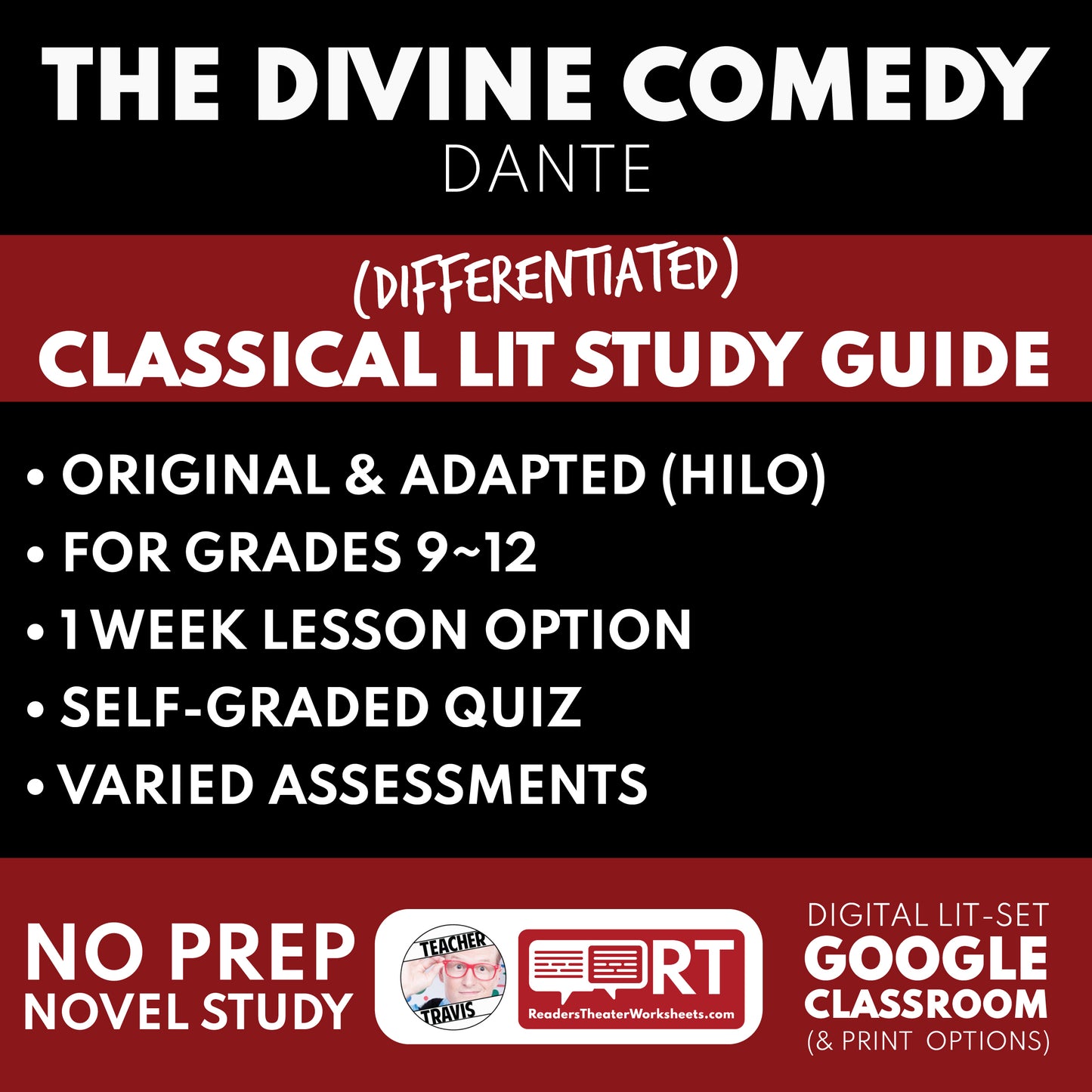
The Divine Comedy by Dante Alighieri Differentiated Classical Lit Study Guide for Grades 9 to 12
The Divine Comedy by Dante Alighieri Differentiated Classical Lit Study Guide for Grades 9 to 12
Couldn't load pickup availability
Classroom Use at a Glance
A differentiated literature study guide for grades 9–12 using The Divine Comedy by Dante Alighieri Differentiated Classical Lit Study Guide for Grades 9 to 12. Built to support mixed reading levels, close reading, vocabulary, discussion, assessment, and no-prep ELA instruction.
Classroom Uses Close Reading, Discussion, Assessment, Whole Class, Homework, Sub Plan view all
- Close Reading
- Discussion
- Assessment
- Whole Class
- Homework
- Sub Plan
Included Original Text, Leveled Text, Teacher Guide, Student Worksheet, Answer Key, Quiz, Google Forms Quiz, Vocabulary, Discussion Questions, Writing Prompt view all
- Original Text
- Leveled Text
- Teacher Guide
- Student Worksheet
- Answer Key
- Quiz
- Google Forms Quiz
- Vocabulary
- Discussion Questions
- Writing Prompt
Format PDF, DOCX, Google Docs, Google Forms, Online Library Access, Printable, Editable view all
- DOCX
- Google Docs
- Google Forms
- Online Library Access
- Printable
- Editable
Differentiation Original Version, Leveled Version, Mixed Reading Levels, Vocabulary Support, Struggling Readers, Advanced Readers view all
- Original Version
- Leveled Version
- Mixed Reading Levels
- Vocabulary Support
- Struggling Readers
- Advanced Readers
Problem: Most classic novel studies break down in real classrooms for two reasons: the original text is long and demanding, and student reading levels inside one class are rarely uniform—so teachers end up building separate tracks or simplifying discussions until the unit loses rigor.
Here’s the solution: This differentiated novel study / digital lit-set for The Divine Comedy by Dante Alighieri solves that problem by giving you both the complete original text and a condensed, five-part adapted version, so you can keep the class moving together while students read at the level that fits. Every discussion question, multiple-choice exit quiz, short-answer item, and challenge question works for both tracks, so you can run one coherent unit without rewriting prompts, re-keying tests, or splitting the class into separate curricula.
Perfect for Grades 9–12 novel study units focused on text evidence, moral complexity, symbolism, structure, author choices, academic vocabulary, and high-quality discussion.
How can I be sure this resource will meet my needs?
1) Open in full view the first preview thumbnail and read the Adapted Version sample to see if the text is suitable for your classroom's reading level.
2) Also, you can test drive these similar digital lit sets for FREE!
- [FREE DOWNLOAD] The Great Gatsby Differentiated Novel Study
- [FREE DOWNLOAD] Adapted Peter Pan Differentiated Novel Study
- [FREE DOWNLOAD] The Wonderful Wizard of Oz Adapted Version
- [FREE DOWNLOAD] A Christmas Carol Adapted Version
SAVE 40% and get the Full Bundle: 8 Differentiated Ancient & Medieval Western Literature Study Guides
Quick Guide for Teachers:
Adapted-Only Track (Fastest: 5-Day Model)
- Best for Grades 9–12 classes that need a manageable, one-week novel experience.
- Day 1–5: Students read one adapted part per day and use the matching Main Ideas & Themes Discussion Questions and self-grading multiple-choice quiz.
- End the week with the Final Worksheet (Vocabulary Words, Short Answer Questions, and Challenge Questions).
- This track keeps lessons tight, predictable, and complete in five days.
Original-Only Track (Longer: Multi-Day Per Section)
- Ideal for stronger readers or classes ready for original language and sentence structure.
- Students read the original chapters/books aligned to each adapted Part.
- Use the same Discussion Questions, MC exit quizzes, and Final Worksheet; all items are text-accurate for both versions.
- Vocabulary Words (10) are usable for both tracks, because each word appears in both the adapted text and the corresponding original chapters/books.
- This track preserves the full descriptive style and classic voice while giving you ready-made, age-appropriate assessments.
Dual-Track Differentiation (Mixed Readers, Flexible Timelines)
- Lets your entire class study the same plot, scenes, and themes at the same time—even when some students need the adapted text and others handle the full novel.
- Assign adapted Part 1 to students who need a shorter, clearer text and original corresponding chapters/books to students reading the full text; repeat this pattern through Parts 2–5 (timing will depend on your classroom's reading level).
- Give original-text students multiple days per section while adapted-text students reread key scenes, complete vocabulary tasks, and tackle discussion questions in pairs or small groups.
- All assessments are usable for both tracks: Discussion Questions, MC Exit Quizzes for each Part, and the Final Worksheet (Vocabulary, Short Answer, and Challenge Questions).
This product includes a zip file consisting of:
NOTE: All files are editable and include (PDF, DOCX, PPTX, Google Docs/Slides/Forms).
Full Original Text: ~114,000 words | 8.5 Flesch-Kincaid GL
- Lexile Ranges: ~955L - 1250L | CEFR ~B1+ / B2
- Great for advanced readers, extension groups, honors classes, and longer-term novel studies.
- BONUS: Free Access to the text on our LEVELED-LIT CLASSICS Library Platform.
Adapted Version Text: ~15,435 words | 4.6 Flesch-Kincaid GL
- Lexile Ranges: ~700L - 950L | CEFR ~A2+ / B1
- Divided into 5 parts for easy daily reading sessions.
- *Both versions tell the same story, allowing students to participate in shared discussions even when reading different texts.
Student Final Worksheet/Quizzes (PPTX, Google Slides/Forms)
- 10 Vocabulary Words
- 10 Short Answer Recall/Comprehension
- 5 Challenge Questions (synthesis, analysis, themes, real life connection)
- 5 Multiple Choice Quizzes (20 Questions) (1 per part)
Teacher’s Guide & Answer Key
- 5 Sets of Daily Discussion Questions (1 per part)
- 5 Sets of Self-Graded Exit Quizzes (1 per part, 20Qs each)
- Answer Keys for Vocab, Short Answer, and Challenge Questions
- Key Figures & Places reference sheets to help students track characters and settings
What’s the Tradeoff of Using the Adapted Version?
Pros:
- Reduces the text to a fraction of its original length, fitting neatly into a one-week unit.
- Well suited for shorter attention spans and developing readers in Grades 9–10.
- Preserves core narrative elements, characters, and themes.
- Far better than skipping the book entirely due to time limits or reading-level concerns.
- Works for whole-class read-alouds, small-group novel studies, independent reading, or focused close-reading lessons.
Cons:
- Omits some original language, side scenes, and descriptive passages for brevity, so students do not see every nuance of the original author's style.
- Leaves fewer opportunities for deep line-by-line stylistic analysis than a full-length, multi-week novel study.
Bottom Line:
If you have the time and budget, nothing beats the feel of a real paperback in every student’s hands. But when time, copies, and reading levels are real constraints, a digital literature set like this—adapted text + original text mapping + shared assessments—lets you bring this classic into your classroom instead of leaving it on the “maybe someday” shelf. If you were to buy traditional paperbacks at about $7 per book for 30 students, that is a $210 investment. This digital lit-set gives you a reusable, print-friendly alternative you can adapt for many years and multiple groups.
Adapted Version Summary (and source chapters)
Part 1 – The Dark Wood and the First Descent
Adapted from: Hell Cantos 1–20 of the original poem.
The journey begins in fear and disorientation, then becomes purposeful once the narrator accepts guidance and enters a moral landscape where choices leave permanent marks. Early encounters establish the logic of consequence through vivid punishments that expose desire, cowardice, and self-deception. As the descent continues, the narrator’s pity is tested against the claim that justice is structured, not sentimental. By the end, the traveler has crossed from shock into disciplined observation, seeing how wrongdoing becomes a visible reality.
Part 2 – Ditches of Fraud and the Turn Toward the Mountain
Adapted from: Hell Cantos 21–34; Purgatory Cantos 1–6 of the original poem.
The punishments sharpen into a system where deception, manipulation, and betrayal are treated as especially corrupting because they damage trust itself. The journey reaches the deepest region, where treachery is frozen into place and the turning point is physical as well as moral. Emerging from the underworld, the atmosphere shifts: instead of a fixed sentence, the new realm demands effort, waiting, and instruction. Early Purgatory introduces hope as something real—but only if the soul stops delaying change and begins practicing discipline.
Part 3 – Terraces of Cleansing and the Reordering of Desire
Adapted from: Purgatory Cantos 7–26 of the original poem.
The climb becomes a sustained education in how desire goes wrong and how it can be redirected toward what is good. Each terrace offers examples, prayers, conversations, and embodied corrections that train perception as much as behavior. The narrator learns that freedom is not mere impulse; it requires honest self-knowledge and the willingness to be reshaped. Progress is incremental and communal, emphasizing how memory, love, and responsibility can either trap a person or set them moving upward.
Part 4 – The Summit Garden and the First Heavens
Adapted from: Purgatory Cantos 27–33; Paradise Cantos 1–13 of the original poem.
The final barriers of Purgatory demand full consent to cleansing, pushing the narrator from understanding into committed change. At the summit, the Earthly Paradise presents restoration as ordered, purposeful, and rooted in truth rather than comfort. A major shift in guidance occurs as the journey moves from reason-led correction into love-led illumination. The opening heavens introduce a new mode of learning—questions, explanations, and moral testing about vows, justice, desire, and the harmony of wisdom.
Part 5 – The Higher Spheres and the Final Vision
Adapted from: Paradise Cantos 14–33 of the original poem.
The ascent deepens into encounters where personal history, civic order, theology, and cosmic hierarchy combine into a single argument about meaning and value. The narrator is examined on faith, hope, and love, showing that readiness for final vision requires lived virtue, not merely remarkable experience. Institutional critique and moral seriousness intensify as the poem presses toward unity and the limits of language. The climax holds together revelation and resolution: the narrator’s desire is steadied, and reality is framed as ordered by love itself.
Frequently Asked Questions
Can I use the adapted text for reluctant or below-level readers without watering down the unit?
Yes. The adapted version is approximately 15,435 words at a 4.6 Flesch-Kincaid Grade Level, so students can complete a rigorous novel study with manageable reading volume while still engaging the same core journey, moral structure, and thematic questions as the original track.
Is this aligned to high school ELA standards for Grades 9–12?
Yes. The tasks are built around text evidence, theme development, complex character and moral analysis, figurative language and symbolism, structure, point of view, and discussion—aligning to RL, SL, and L clusters appropriate to Grades 9–12.
How does the differentiation work if some students read the original and others read the adapted version?
Because the chapter map keeps Parts 1–5 aligned to the same narrative arc, students can read different versions while answering the same questions: every discussion prompt, quiz item, short-answer question, and challenge question is designed to be answerable from either track.
CCSS Standards
Reading Literature: CCSS RL.9-10.1, CCSS RL.9-10.2, CCSS RL.9-10.3, CCSS RL.9-10.4, CCSS RL.9-10.5, CCSS RL.9-10.6, CCSS RL.11-12.1, CCSS RL.11-12.2, CCSS RL.11-12.3, CCSS RL.11-12.4, CCSS RL.11-12.5, CCSS RL.11-12.6
Speaking & Listening: CCSS SL.9-10.1, CCSS SL.11-12.1
Language: CCSS L.9-10.4, CCSS L.11-12.4
Anchor Standards: CCRA.R.1, CCRA.R.2, CCRA.R.3, CCRA.R.4, CCRA.R.5, CCRA.R.6, CCRA.W.1, CCRA.W.2, CCRA.W.9, CCRA.SL.1, CCRA.L.1, CCRA.L.2, CCRA.L.4
Share