Readers Theater Worksheets
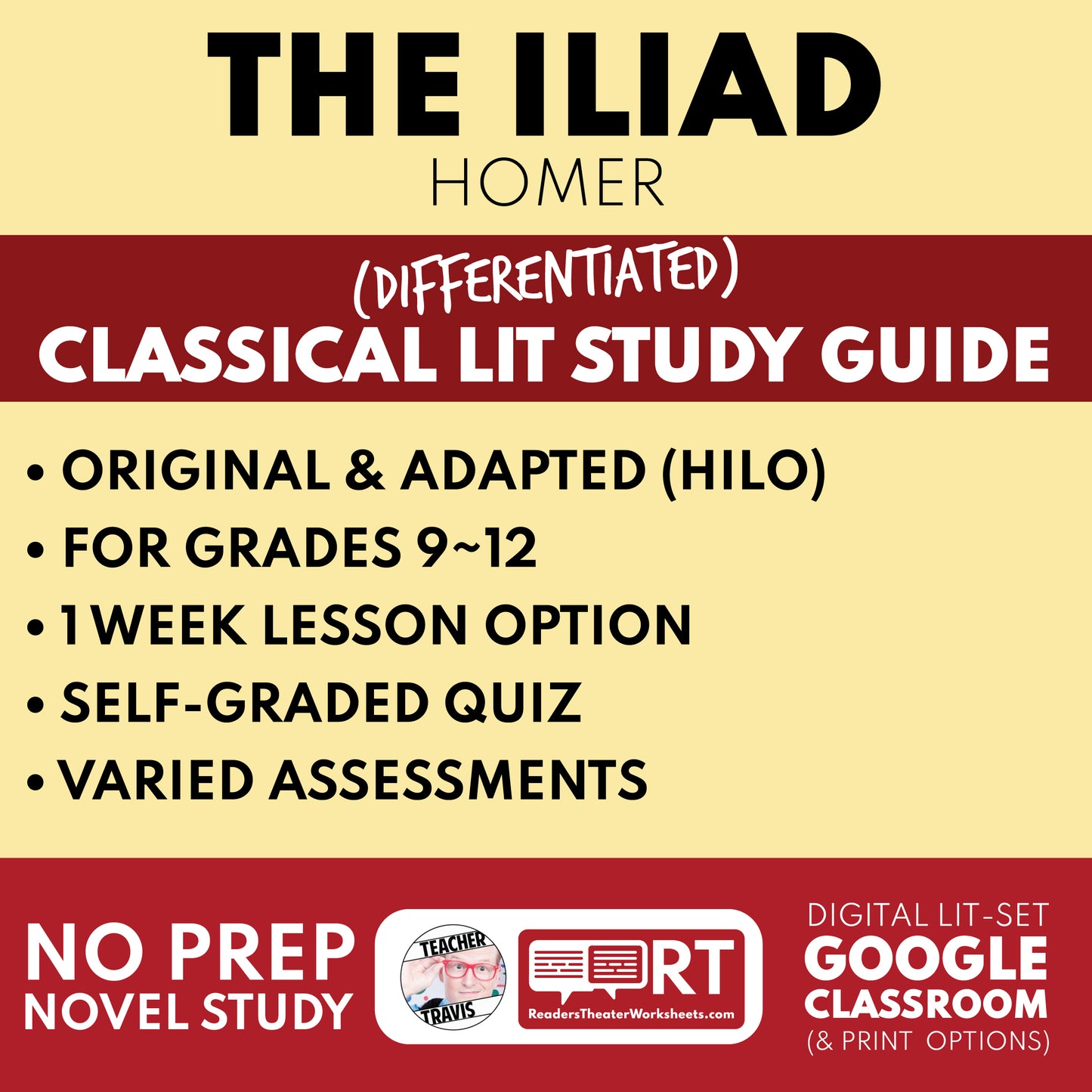
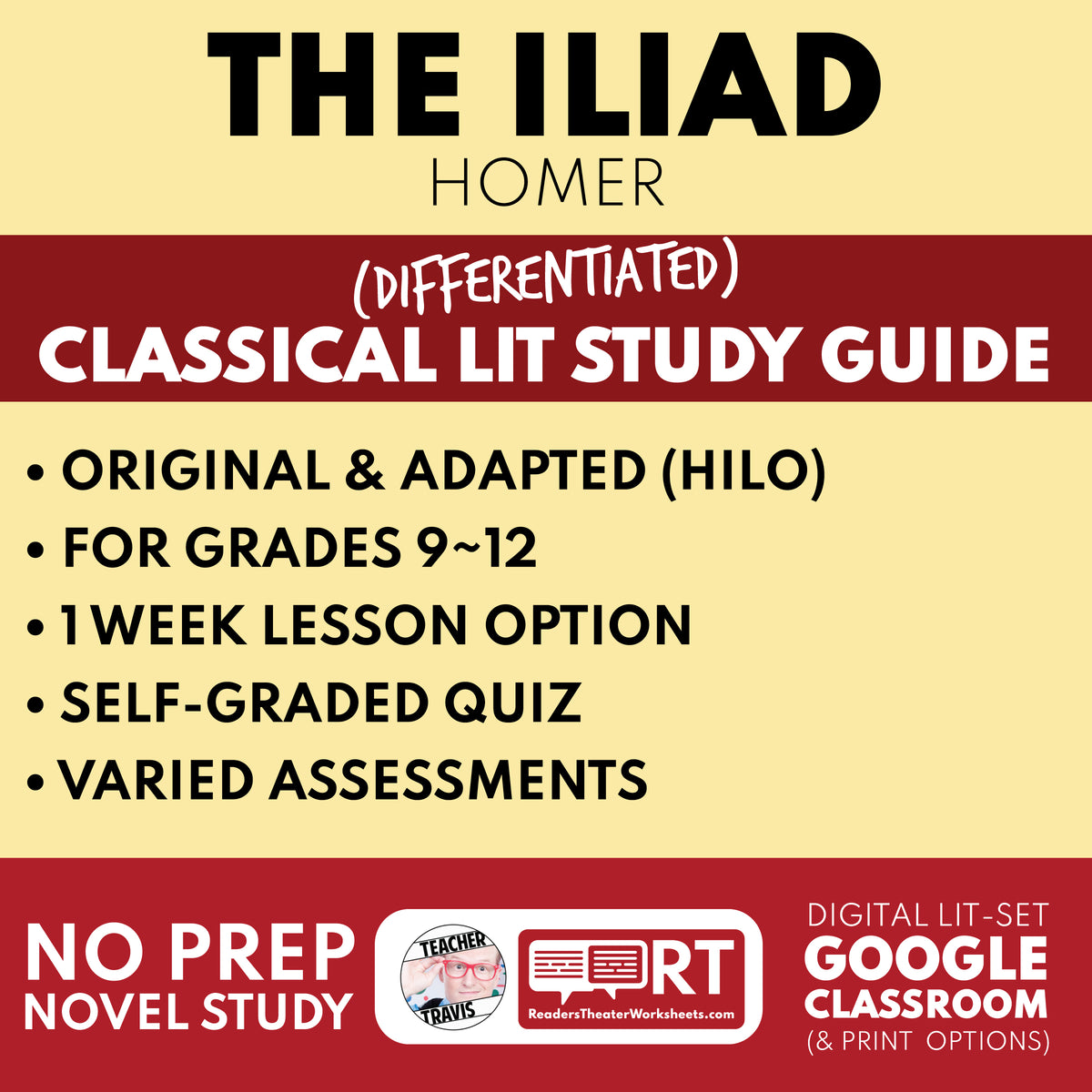
The Iliad by Homer Differentiated Classical Lit Study Guide for Grades 9 to 12
The Iliad by Homer Differentiated Classical Lit Study Guide for Grades 9 to 12
Couldn't load pickup availability
Classroom Use at a Glance
A differentiated literature study guide for grades 9–12 using The Iliad by Homer Differentiated Classical Lit Study Guide for Grades 9 to 12. Built to support mixed reading levels, close reading, vocabulary, discussion, assessment, and no-prep ELA instruction.
Classroom Uses Close Reading, Discussion, Assessment, Whole Class, Homework, Sub Plan view all
- Close Reading
- Discussion
- Assessment
- Whole Class
- Homework
- Sub Plan
Included Original Text, Leveled Text, Teacher Guide, Student Worksheet, Answer Key, Quiz, Google Forms Quiz, Vocabulary, Discussion Questions, Writing Prompt view all
- Original Text
- Leveled Text
- Teacher Guide
- Student Worksheet
- Answer Key
- Quiz
- Google Forms Quiz
- Vocabulary
- Discussion Questions
- Writing Prompt
Format PDF, DOCX, Google Docs, Google Forms, Online Library Access, Printable, Editable view all
- DOCX
- Google Docs
- Google Forms
- Online Library Access
- Printable
- Editable
Differentiation Original Version, Leveled Version, Mixed Reading Levels, Vocabulary Support, Struggling Readers, Advanced Readers view all
- Original Version
- Leveled Version
- Mixed Reading Levels
- Vocabulary Support
- Struggling Readers
- Advanced Readers
Problem: Teachers rarely have time to run a full classic epic with mixed reading levels—especially when the original text is long, dense, and structurally unfamiliar to many students. The result is often a rushed unit, uneven comprehension, or a class split between students who can access the text and students who cannot.
Here’s the solution: This differentiated novel study solves that problem with a complete dual-track “digital lit-set” for The Iliad: it includes the full original text alongside a streamlined five-part adapted version, so you can keep the same instructional arc while adjusting reading load. Every discussion question, multiple-choice exit quiz, short-answer item, and challenge question works for both tracks—meaning students can read different versions while you run one coherent set of assessments focused on shared, text-central events, motives, and themes.
Perfect for Grades 9–12 classrooms that need rigorous, text-dependent practice with character conflict, theme development, structure, and evidence-based discussion—without requiring every student to carry the same reading burden.
How can I be sure this resource will meet my needs?
1) Open in full view the first preview thumbnail and read the Adapted Version sample to see if the text is suitable for your classroom's reading level.
2) Also, you can test drive these similar digital lit sets for FREE!
- [FREE DOWNLOAD] The Great Gatsby Differentiated Novel Study
- [FREE DOWNLOAD] Adapted Peter Pan Differentiated Novel Study
- [FREE DOWNLOAD] The Wonderful Wizard of Oz Adapted Version
- [FREE DOWNLOAD] A Christmas Carol Adapted Version
SAVE 40% and get the Full Bundle: 8 Differentiated Ancient & Medieval Western Literature Study Guides
Quick Guide for Teachers:
Adapted-Only Track (Fastest: 5-Day Model)
- Best for Grades 9–12 classes that need a manageable, one-week novel experience.
- Day 1–5: Students read one adapted part per day and use the matching Main Ideas & Themes Discussion Questions and self-grading multiple-choice quiz.
- End the week with the Final Worksheet (Vocabulary Words, Short Answer Questions, and Challenge Questions).
- This track keeps lessons tight, predictable, and complete in five days.
Original-Only Track (Longer: Multi-Day Per Section)
- Ideal for stronger readers or classes ready for original language and sentence structure.
- Students read the original chapters/books aligned to each adapted Part.
- Use the same Discussion Questions, MC exit quizzes, and Final Worksheet; all items are text-accurate for both versions.
- Vocabulary Words (10) are usable for both tracks, because each word appears in both the adapted text and the corresponding original chapters/books.
- This track preserves the full descriptive style and classic voice while giving you ready-made, age-appropriate assessments.
Dual-Track Differentiation (Mixed Readers, Flexible Timelines)
- Lets your entire class study the same plot, scenes, and themes at the same time—even when some students need the adapted text and others handle the full novel.
- Assign adapted Part 1 to students who need a shorter, clearer text and original corresponding chapters/books to students reading the full text; repeat this pattern through Parts 2–5 (timing will depend on your classroom's reading level).
- Give original-text students multiple days per section while adapted-text students reread key scenes, complete vocabulary tasks, and tackle discussion questions in pairs or small groups.
- All assessments are usable for both tracks: Discussion Questions, MC Exit Quizzes for each Part, and the Final Worksheet (Vocabulary, Short Answer, and Challenge Questions).
This product includes a zip file consisting of:
NOTE: All files are editable and include (PDF, DOCX, PPTX, Google Docs/Slides/Forms).
Full Original Text: ~154,442 words | 13.94 Flesch-Kincaid GL
- Lexile Ranges: ~1270L - 1605L | CEFR ~C1+
- Great for advanced readers, extension groups, honors classes, and longer-term novel studies.
- BONUS: Free Access to the text on our LEVELED-LIT CLASSICS Library Platform.
Adapted Version Text: ~14,424 words | 6.44 Flesch-Kincaid GL
- Divided into 5 parts for easy daily reading sessions.
- *Both versions tell the same story, allowing students to participate in shared discussions even when reading different texts.
Student Final Worksheet/Quizzes (PPTX, Google Slides/Forms)
- 10 Vocabulary Words
- 10 Short Answer Recall/Comprehension
- 5 Challenge Questions (synthesis, analysis, themes, real life connection)
- 5 Multiple Choice Quizzes (20 Questions) (1 per part)
Teacher’s Guide & Answer Key
- 5 Sets of Daily Discussion Questions (1 per part)
- 5 Sets of Self-Graded Exit Quizzes (1 per part, 20Qs each)
- Answer Keys for Vocab, Short Answer, and Challenge Questions
- Key Figures & Places reference sheets to help students track characters and settings
What’s the Tradeoff of Using the Adapted Version?
Pros:
- Reduces the text to a fraction of its original length, fitting neatly into a one-week unit.
- Well suited for shorter attention spans and developing readers in Grades 9–10.
- Preserves core narrative elements, characters, and themes.
- Far better than skipping the book entirely due to time limits or reading-level concerns.
- Works for whole-class read-alouds, small-group novel studies, independent reading, or focused close-reading lessons.
Cons:
- Omits some original language, side scenes, and descriptive passages for brevity, so students do not see every nuance of the original author's style.
- Leaves fewer opportunities for deep line-by-line stylistic analysis than a full-length, multi-week novel study.
Bottom Line:
If you have the time and budget, nothing beats the feel of a real paperback in every student’s hands. But when time, copies, and reading levels are real constraints, a digital literature set like this—adapted text + original text mapping + shared assessments—lets you bring this classic into your classroom instead of leaving it on the “maybe someday” shelf. If you were to buy traditional paperbacks at about $7 per book for 30 students, that is a $210 investment. This digital lit-set gives you a reusable, print-friendly alternative you can adapt for many years and multiple groups.
Adapted Version Summary (and source chapters)
Part 1 – The Quarrel That Unleashes the War
Adapted from: Books I–V of the original epic.
Achilles’ conflict with Agamemnon fractures the Greek alliance at the worst possible time, and the consequences spill immediately into suffering for ordinary soldiers. Honor is established as both social law and weapon, while the gods begin steering outcomes in ways humans cannot fully control. Attempts to contain the crisis fail, and the war escalates into sustained violence.
Part 2 – Hector’s Pressure and the Refusal to Return
Adapted from: Books VI–IX of the original epic.
With Achilles absent, the Trojans gain momentum and the Greek camp becomes exposed and desperate. Hector’s leadership is shown through battle decisions and the strain between public duty and private family bonds. Greek leaders attempt persuasion through an embassy, testing whether apology, gifts, and friendship can reverse humiliation.
Part 3 – The Wall Breaks and the Ships Are Threatened
Adapted from: Books X–XV of the original epic.
Night missions and repeated tactical shocks push the Greeks into a defensive crisis. The wall and trench fail to guarantee safety, and divine influence repeatedly tilts momentum. By the end of this section, the Trojans reach the ships and fire becomes a real threat, forcing the story toward drastic intervention.
Part 4 – Patroclus Enters, and the Cost Becomes Personal
Adapted from: Books XVI–XVIII of the original epic.
Patroclus fights in borrowed armor to save the fleet, creating a surge of hope that turns into irreversible loss. The struggle over bodies, honor, and grief intensifies, and Achilles’ priorities shift from political quarrel to personal reckoning. The poem pivots toward vengeance and consequence rather than strategy alone.
Part 5 – Achilles Returns: Rampage, Death, and Human Reckoning
Adapted from: Books XIX–XXIV of the original epic.
Achilles reconciles with Agamemnon and returns to war fully armed, transforming the battlefield into a contest of unstoppable force and doomed resistance. His fury culminates in Hector’s death and the prolonged humiliation of the dead, until the story presses toward ransom and restored ritual order. The epic ends through mourning and burial rather than celebration.
Frequently Asked Questions
Can I use the adapted version for reluctant or below-level readers without “dumbing it down”?
Yes. The adapted five-part text keeps the same core events, motives, and themes while reducing reading load (about 14,424 words; FK 6.44), so students can participate in Grades 9–12 analysis with more accessible prose.
Is this aligned to high school ELA standards?
Yes. The tasks align to RL (evidence, theme, character, structure), SL (discussion), and L (academic vocabulary and word meaning) clusters supported by the prompts and assessments in this unit.
How does differentiation work if students read different versions?
Both tracks follow the same Part 1–5 map (Books I–V, VI–IX, X–XV, XVI–XVIII, XIX–XXIV). Students read either version by Part, and all assessments target shared, text-central material present in both.
CCSS Standards
Reading Literature: CCSS RL.9-10.1, CCSS RL.9-10.2, CCSS RL.9-10.3, CCSS RL.9-10.4, CCSS RL.9-10.5, CCSS RL.9-10.6, CCSS RL.11-12.1, CCSS RL.11-12.2, CCSS RL.11-12.3, CCSS RL.11-12.4, CCSS RL.11-12.5, CCSS RL.11-12.6
Speaking & Listening: CCSS SL.9-10.1, CCSS SL.11-12.1
Language: CCSS L.9-10.4, CCSS L.11-12.4
Anchor Standards: CCRA.R.1, CCRA.R.2, CCRA.R.3, CCRA.R.4, CCRA.R.5, CCRA.R.6, CCRA.W.1, CCRA.W.2, CCRA.W.9, CCRA.SL.1, CCRA.L.1, CCRA.L.2, CCRA.L.4
Share