Readers Theater Worksheets
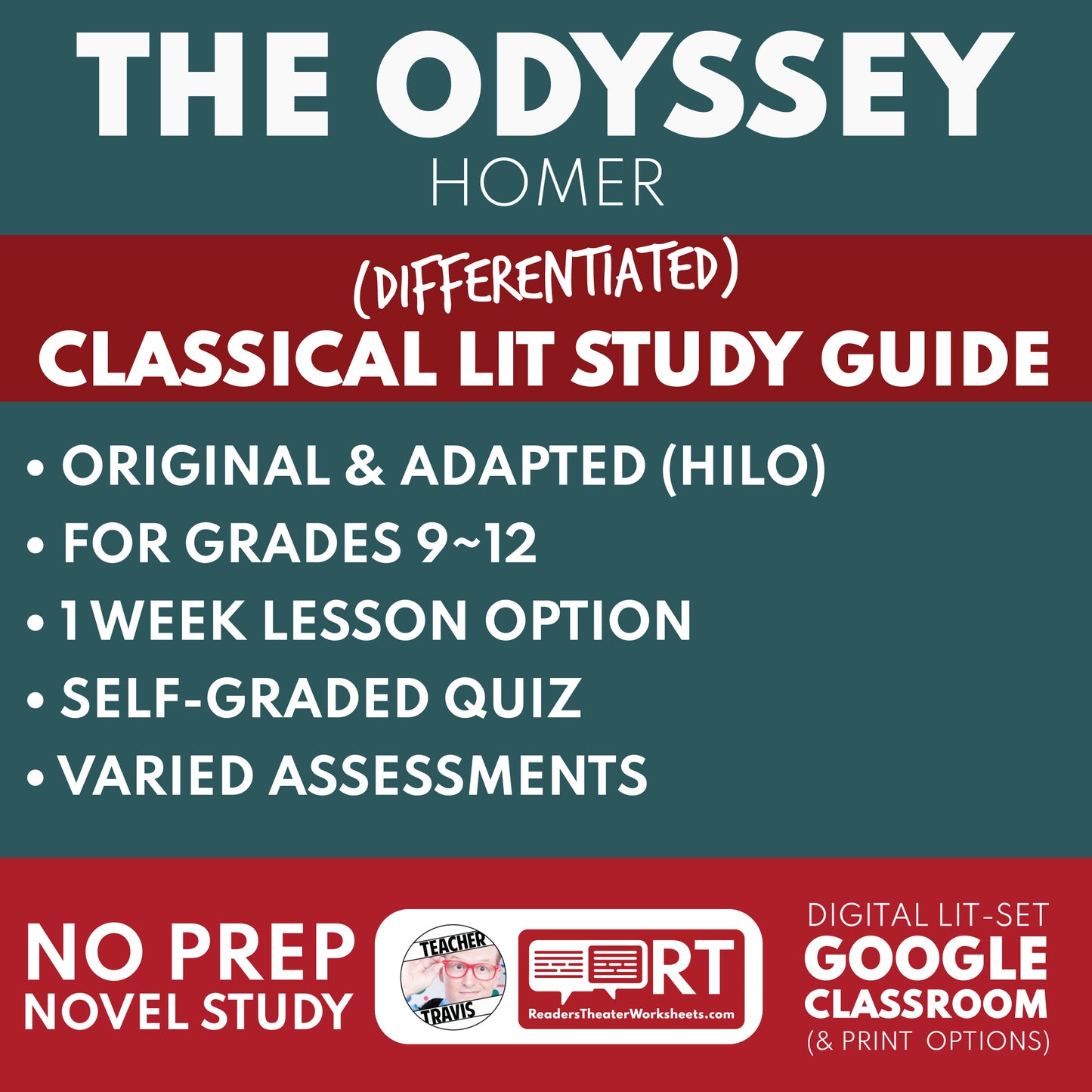
The Odyssey by Homer Differentiated Classical Lit Study Guide for Grades 9 to 12
The Odyssey by Homer Differentiated Classical Lit Study Guide for Grades 9 to 12
Couldn't load pickup availability
Classroom Use at a Glance
A differentiated literature study guide for grades 9–12 using The Odyssey by Homer Differentiated Classical Lit Study Guide for Grades 9 to 12. Built to support mixed reading levels, close reading, vocabulary, discussion, assessment, and no-prep ELA instruction.
Classroom Uses Close Reading, Discussion, Assessment, Whole Class, Homework, Sub Plan view all
- Close Reading
- Discussion
- Assessment
- Whole Class
- Homework
- Sub Plan
Included Original Text, Leveled Text, Teacher Guide, Student Worksheet, Answer Key, Quiz, Google Forms Quiz, Vocabulary, Discussion Questions, Writing Prompt view all
- Original Text
- Leveled Text
- Teacher Guide
- Student Worksheet
- Answer Key
- Quiz
- Google Forms Quiz
- Vocabulary
- Discussion Questions
- Writing Prompt
Format PDF, DOCX, Google Docs, Google Forms, Online Library Access, Printable, Editable view all
- DOCX
- Google Docs
- Google Forms
- Online Library Access
- Printable
- Editable
Differentiation Original Version, Leveled Version, Mixed Reading Levels, Vocabulary Support, Struggling Readers, Advanced Readers view all
- Original Version
- Leveled Version
- Mixed Reading Levels
- Vocabulary Support
- Struggling Readers
- Advanced Readers
Problem: Many teachers want to teach classic literature, but the full text can be too long for limited class time—and a single reading level rarely fits an entire room. Planning separate materials for mixed abilities is time-consuming, and it often results in uneven pacing, inconsistent discussions, and students who fall behind before the most important turning points.
Here’s the solution: This differentiated The Odyssey by Homer novel study / digital lit-set solves that problem by giving you two complete reading tracks that stay perfectly aligned: the full original text of The Odyssey plus a streamlined, five-part adapted version that preserves the core plot, major episodes, character motivations, and moral complexity. Every discussion question, multiple-choice exit quiz, short-answer item, and challenge question works for both tracks—so you can teach one cohesive unit while students read at the level that best supports comprehension and confidence.
Perfect for Grades 9–12 ELA classrooms, small groups, intervention + extension pairing, and literature circles. Skills supported include evidence-based analysis, character motivation and change, theme development, structure, and academic discussion and writing aligned to CCSS expectations.
How can I be sure this resource will meet my needs?
1) Open in full view the first preview thumbnail and read the Adapted Version sample to see if the text is suitable for your classroom's reading level.
2) Also, you can test drive these similar digital lit sets for FREE!
- [FREE DOWNLOAD] The Great Gatsby Differentiated Novel Study
- [FREE DOWNLOAD] Adapted Peter Pan Differentiated Novel Study
- [FREE DOWNLOAD] The Wonderful Wizard of Oz Adapted Version
- [FREE DOWNLOAD] A Christmas Carol Adapted Version
SAVE 40% and get the Full Bundle: 8 Differentiated Ancient & Medieval Western Literature Study Guides
Quick Guide for Teachers:
Adapted-Only Track (Fastest: 5-Day Model)
- Best for Grades 9–12 classes that need a manageable, one-week novel experience.
- Day 1–5: Students read one adapted part per day and use the matching Main Ideas & Themes Discussion Questions and self-grading multiple-choice quiz.
- End the week with the Final Worksheet (Vocabulary Words, Short Answer Questions, and Challenge Questions).
- This track keeps lessons tight, predictable, and complete in five days.
Original-Only Track (Longer: Multi-Day Per Section)
- Ideal for stronger readers or classes ready for original language and sentence structure.
- Students read the original chapters/books aligned to each adapted Part.
- Use the same Discussion Questions, MC exit quizzes, and Final Worksheet; all items are text-accurate for both versions.
- Vocabulary Words (10) are usable for both tracks, because each word appears in both the adapted text and the corresponding original chapters/books.
- This track preserves the full descriptive style and classic voice while giving you ready-made, age-appropriate assessments.
Dual-Track Differentiation (Mixed Readers, Flexible Timelines)
- Lets your entire class study the same plot, scenes, and themes at the same time—even when some students need the adapted text and others handle the full novel.
- Assign adapted Part 1 to students who need a shorter, clearer text and original corresponding chapters/books to students reading the full text; repeat this pattern through Parts 2–5 (timing will depend on your classroom's reading level).
- Give original-text students multiple days per section while adapted-text students reread key scenes, complete vocabulary tasks, and tackle discussion questions in pairs or small groups.
- All assessments are usable for both tracks: Discussion Questions, MC Exit Quizzes for each Part, and the Final Worksheet (Vocabulary, Short Answer, and Challenge Questions).
This product includes a zip file consisting of:
NOTE: All files are editable and include (PDF, DOCX, PPTX, Google Docs/Slides/Forms).
Full Original Text: ~118,000 words | 14.4 Flesch-Kincaid GL
- Great for advanced readers, extension groups, honors classes, and longer-term novel studies.
- BONUS: Free Access to the text on our LEVELED-LIT CLASSICS Library Platform.
Adapted Version Text: ~17,000 words | 6.1 Flesch-Kincaid GL
- Divided into 5 parts for easy daily reading sessions.
- *Both versions tell the same story, allowing students to participate in shared discussions even when reading different texts.
Student Final Worksheet/Quizzes (PPTX, Google Slides/Forms)
- 10 Vocabulary Words
- 10 Short Answer Recall/Comprehension
- 5 Challenge Questions (synthesis, analysis, themes, real life connection)
- 5 Multiple Choice Quizzes (20 Questions) (1 per part)
Teacher’s Guide & Answer Key
- 5 Sets of Daily Discussion Questions (1 per part)
- 5 Sets of Self-Graded Exit Quizzes (1 per part, 20Qs each)
- Answer Keys for Vocab, Short Answer, and Challenge Questions
- Key Figures & Places reference sheets to help students track characters and settings
What’s the Tradeoff of Using the Adapted Version?
Pros:
- Reduces the text to a fraction of its original length, fitting neatly into a one-week unit.
- Well suited for shorter attention spans and developing readers in Grades 9–10.
- Preserves core narrative elements, characters, and themes.
- Far better than skipping the book entirely due to time limits or reading-level concerns.
- Works for whole-class read-alouds, small-group novel studies, independent reading, or focused close-reading lessons.
Cons:
- Omits some original language, side scenes, and descriptive passages for brevity, so students do not see every nuance of the original author's style.
- Leaves fewer opportunities for deep line-by-line stylistic analysis than a full-length, multi-week novel study.
Bottom Line:
If you have the time and budget, nothing beats the feel of a real paperback in every student’s hands. But when time, copies, and reading levels are real constraints, a digital literature set like this—adapted text + original text mapping + shared assessments—lets you bring this classic into your classroom instead of leaving it on the “maybe someday” shelf. If you were to buy traditional paperbacks at about $7 per book for 30 students, that is a $210 investment. This digital lit-set gives you a reusable, print-friendly alternative you can adapt for many years and multiple groups.
Adapted Version Summary (and source chapters)
Part 1 – Ithaca Without a King
Adapted from: Books I–IV of the original epic.
Telemachus lives under siege as suitors feast in Odysseus’s house and pressure Penelope to choose a husband. Athena pushes Telemachus toward public action, and an assembly exposes how the community’s inaction enables corruption. Telemachus travels to seek news and guidance, learning Odysseus is still alive, while the suitors plot to ambush him on his return.
Part 2 – Release, Storm, and the Court of Scheria
Adapted from: Books V–VIII of the original epic.
Zeus orders Odysseus released from long captivity, and Odysseus builds a raft and risks the open sea. A brutal storm nearly kills him, but he endures and reaches the Phaeacians’ land, where Nausicaa helps him approach the palace safely. Hospitality becomes protection and a path home, and Odysseus’s emotional response to songs about Troy pushes the story toward revelation.
Part 3 – Wanderings and the Cost of Temptation
Adapted from: Books IX–XII of the original epic.
Odysseus recounts disasters driven by hunger, curiosity, pride, and disobedience: raids that invite retaliation, monsters that demand strategy, and temptations that weaken discipline. The Underworld deepens the story’s moral weight through prophecy and hard truths about glory and consequence. The crew’s final violation—slaughtering the Sun-god’s cattle—ends in divine punishment that leaves Odysseus alone.
Part 4 – The Beggar Returns
Adapted from: Books XIII–XVII of the original epic.
Odysseus arrives in Ithaca but returns in disguise to prevent detection while he measures loyalties and gathers allies. Eumaeus’s humble hospitality contrasts with the palace’s moral decay, and Athena arranges a private reunion between Odysseus and Telemachus. Odysseus enters his own home as a beggar, watching the suitors’ cruelty while holding back for the moment that will decide everything.
Part 5 – The Bow, the Reckoning, and the Peace
Adapted from: Books XVIII–XXIV of the original epic.
The suitors turn humiliation into entertainment, but Odysseus’s restraint protects a larger plan. Penelope’s bow contest becomes the turning point: Odysseus proves identity through skill, traps the suitors, and enforces judgment. Penelope’s final test confirms truth through private knowledge rather than appearances, and the ending addresses the public danger of revenge until peace is imposed to end the cycle.
Frequently Asked Questions
Can I use the adapted text with reluctant or below-level readers without changing the unit?
Yes. The adapted version is ~17,000 words at a 6.1 Flesch-Kincaid Grade Level, and every assessment in this unit is designed to work for either reading track—adapted or original—so you do not need separate assignments.
Does this resource align to CCSS for the stated grade band?
Yes. The unit’s tasks support RL (evidence, theme, character, structure), SL (collaborative discussion), and L (academic vocabulary/word meaning) cluster standards appropriate for Grades 9–12.
How does the differentiation work in a real classroom?
Students read either the complete original books or the adapted Part text for the same Part number, then complete the same discussion prompts and assessments. This keeps pacing and conversation unified while supporting mixed reading readiness.
CCSS Standards
Reading Literature: CCSS RL.9-10.1, CCSS RL.9-10.2, CCSS RL.9-10.3, CCSS RL.9-10.4, CCSS RL.9-10.5, CCSS RL.9-10.6, CCSS RL.11-12.1, CCSS RL.11-12.2, CCSS RL.11-12.3, CCSS RL.11-12.4, CCSS RL.11-12.5, CCSS RL.11-12.6
Speaking & Listening: CCSS SL.9-10.1, CCSS SL.11-12.1
Language: CCSS L.9-10.4, CCSS L.11-12.4
Anchor Standards: CCRA.R.1, CCRA.R.2, CCRA.R.3, CCRA.R.4, CCRA.R.5, CCRA.R.6, CCRA.W.1, CCRA.W.2, CCRA.W.9, CCRA.SL.1, CCRA.L.1, CCRA.L.2, CCRA.L.4
Share