
Readers Theater Worksheets
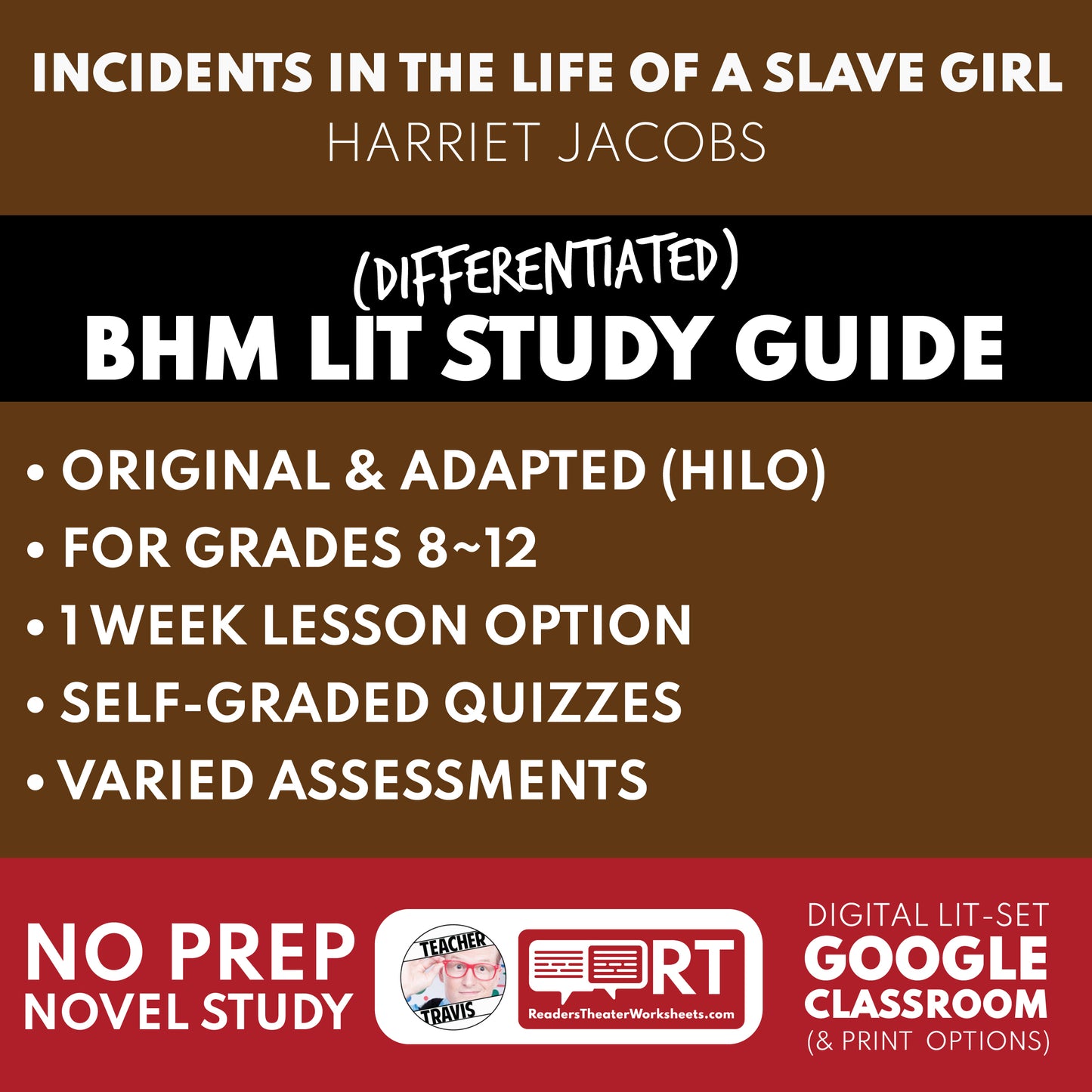
Incidents in the Life of a Slave Girl by Harriet Jacobs Differentiated Study Guide | Black History Month for High School Students
Incidents in the Life of a Slave Girl by Harriet Jacobs Differentiated Study Guide | Black History Month for High School Students
Couldn't load pickup availability
Classroom Use at a Glance
A no-prep differentiated literature study guide for Incidents in the Life of a Slave Girl. Includes original and leveled reading support, comprehension and analysis activities, vocabulary work, discussion prompts, quiz materials, and teacher support for mixed-ability ELA classes.
Classroom Uses Close Reading, Discussion, Assessment, Review, Homework, Sub Plan view all
- Close Reading
- Discussion
- Assessment
- Review
- Homework
- Sub Plan
Included Original Text, Leveled Text, Teacher Guide, Student Worksheet, Quiz, Google Forms Quiz, Answer Key, Vocabulary, Discussion Questions, Writing Prompt view all
- Original Text
- Leveled Text
- Teacher Guide
- Student Worksheet
- Quiz
- Google Forms Quiz
- Answer Key
- Vocabulary
- Discussion Questions
- Writing Prompt
Format PDF, DOCX, Google Docs, Google Forms, Printable, Editable view all
- DOCX
- Google Docs
- Google Forms
- Printable
- Editable
Differentiation Original Version, Leveled Version, Mixed Reading Levels, Vocabulary Support, Struggling Readers, Advanced Readers view all
- Original Version
- Leveled Version
- Mixed Reading Levels
- Vocabulary Support
- Struggling Readers
- Advanced Readers
PROBLEM: Most classic literature study guides break down in real classrooms for two reasons: the original text is long and demanding, and student reading levels inside one class are rarely uniform—so teachers end up building separate tracks or simplifying discussions until the unit loses rigor.
SOLUTION: This differentiated novel study / digital lit-set for Incidents in the Life of a Slave Girl by Harriet Jacobs solves that problem by giving you both the complete original text and a condensed, five-part adapted version, so you can keep the class moving together while students read at the level that fits.
Every discussion question, multiple-choice exit quiz, short-answer item, and challenge question works for both tracks, so you can run one coherent unit without rewriting prompts or splitting your class into separate novel study paths.
Perfect for Grades 8–10 classrooms studying narrative voice, theme development, character motivation under pressure, argument and evidence in discussion, and academic vocabulary—while keeping students anchored in text-based analysis of power, law, family, and moral choice.
Quick Guide for Teachers
Adapted-Only Track (Fastest: 5-Day Model)
Best for Grades 9–12 classes that need a manageable, one-week novel experience. Day 1–5: Students read one adapted part per day and use the matching Main Ideas & Themes Discussion Questions and self-grading multiple-choice quiz. End the week with the Final Worksheet (Vocabulary Words, Short Answer Questions, and Challenge Questions). This track keeps lessons tight, predictable, and complete in five days.
Original-Only Track (Longer: Multi-Day Per Section)
Ideal for stronger readers or classes ready for original language and sentence structure. Students read the original chapters aligned to each adapted Part Use the same Discussion Questions, MC exit quizzes, and Final Worksheet; all items are text-accurate for both versions. Vocabulary Words (10) are usable for both tracks, because each word appears in both the adapted text and the corresponding original chapters. This track preserves the full descriptive style and classic voice while giving you ready-made, age-appropriate assessments.
Dual-Track Differentiation (Mixed Readers, Flexible Timelines)
Lets your entire class study the same plot, scenes, and themes at the same time—even when some students need the adapted text and others handle the full novel. Assign adapted Part 1 to students who need a shorter, clearer text and original corresponding chapters to students reading the full text; repeat this pattern through Parts 2–5 (timing will depend on your classroom's reading level) Give original-text students multiple days per section while adapted-text students reread key scenes, complete vocabulary tasks, and tackle discussion questions in pairs or small groups.
How can I be sure this resource will meet my needs?
1) Open the preview thumbnail and read the first page excerpt of the Adapted Version to see if the text is suitable for your classroom's reading level.
2) First, try a similar FREE RESOURCE:
3) Also, you can test drive these other digital lit sets for FREE!
- [FREE DOWNLOAD] The Great Gatsby Differentiated Novel Study
- [FREE DOWNLOAD] Adapted Peter Pan Differentiated Novel Study
- [FREE DOWNLOAD] The Wonderful Wizard of Oz Adapted Version
- [FREE DOWNLOAD] A Christmas Carol Adapted Version
Get all 5 BHM Study Guides & Save 40% here!
This product includes a zip file consisting of
NOTE: All files are editable and include (PDF, DOCX, PPTX, Google Docs/Slides/Forms)
Full Original Text: ~81,000 words | 6.8 Flesch-Kincaid GL
- Lexile Ranges: ~900L - 1050L | CEFR ~B1-B2
- Great for advanced readers (or 8–10 graders), extension groups, longer-term novel studies.
Adapted Version Text: ~18,000 words | 6.8 Flesch-Kincaid GL
Lexile Ranges: ~900L - 1050L | CEFR ~B1-B2
- Designed for Grades 10-12 with support and access while preserving tone & style
- Supported readers who need a shorter text with the same plot, themes, and assessment alignment.
- *Both versions tell the same story, allowing students to participate in shared discussions even when reading different texts.
FREE BONUS ALERT!
Access Code included to the original and adapted/abridged text on the LEVELED-LIT CLASSICS Library Platform.
Student Final Worksheet/Quizzes (PPTX, Google Slides/Forms)
- 10 Vocabulary Words
- 10 Short Answer Recall/Comprehension
- 5 Challenge Questions (synthesis, analysis, themes, real life connection)
- 5 Multiple Choice Quizzes (20 Questions) (1 per part)
Teacher’s Guide & Answer Key
- 5 Sets of Daily Discussion Questions (1 per part)
- 5 Sets of Self-Graded Exit Quizzes (1 per part, 20Qs each)
- Answer Keys for Vocab, Short Answer, and Challenge Questions
- Key Figures & Places reference sheets to help students track characters and settings
What’s the Tradeoff of Using the Adapted Version?
Pros:
- Reduces the novel to a fraction of its original length, fitting neatly into a one-week unit.
- Well suited for shorter attention spans and developing readers in Grades 9-10
- Preserves core narrative elements, characters, and themes
- Far better than skipping the book entirely due to time limits or reading-level concerns.
- Works for whole-class read-alouds, small-group novel studies, independent reading, or focused close-reading lessons.
Cons:
- Omits some original language, side scenes, and descriptive passages for brevity, so students do not see every nuance of the original author's style.
- Leaves fewer opportunities for deep line-by-line stylistic analysis than a full-length, multi-week novel study.
Adapted Version Summary (and source chapters)
Part 1 – Innocence Undone, Lessons of Ownership
Adapted from: Chapters I–VIII of the original text.
Linda’s early life is shaped by family care and her grandmother’s ingenuity, but slavery’s legal reality intrudes through death, inheritance, and household control. The narrative shows how “ordinary” domestic life can be structured by surveillance, punishment, and misinformation. As Linda enters adolescence, the story clarifies the gendered danger that will define her conflict with Dr. Flint. The part establishes that power can be exercised privately while still protected by law and custom.
Part 2 – Coercion, Motherhood, and the Tightening Net
Adapted from: Chapters IX–XV of the original text.
Dr. Flint’s pursuit becomes systematic—threats, notes, isolation plans, and retaliation meant to make resistance feel impossible. Mrs. Flint’s jealousy intensifies the pressure, turning the home into a space of constant monitoring. Motherhood raises the stakes: Linda’s children become leverage, and every decision is measured against their safety. The part ends with the sense that survival now requires strategy, not hope in promises.
Part 3 – Flight, Pursuit, and the Loophole of Retreat
Adapted from: Chapters XVI–XXII of the original text.
Linda runs, and the fugitive world demands secrecy, quick judgment, and reliance on a few trusted allies. Pursuers use threats and punishment against others to force information, showing how slavery targets entire networks. The “loophole of retreat” becomes a hiding place that keeps her near her children while inflicting severe physical and psychological strain. This section frames endurance as resistance when open freedom is out of reach.
Part 4 – Still in Prison, Then Northward Bound
Adapted from: Chapters XXIII–XXXII of the original text.
Years of concealment continue as a prolonged battle of deception, patience, and narrow escapes from renewed schemes. Linda presses for protection of her children while learning how easily “kindness” and promises can be withdrawn. Letters, misdirection, and assistance networks create a fragile path toward a northern escape. The part culminates in movement toward reunion, but security remains uncertain.
Part 5 – The Long Aftermath: Pursuit, Law, and Freedom
Adapted from: Chapters XXXIII–XLI of the original text.
In the North, Linda finds work and community, but her freedom remains unstable under kidnapping threats, racial prejudice, and the power of national law. The Fugitive Slave Law escalates fear by turning free states into hunting grounds and criminalizing aid. The return of a determined pursuer proves that geography alone cannot undo ownership claims. Freedom is finally secured through purchase, offering relief while exposing the nation’s moral compromise.
Frequently Asked Questions
Can I use the adapted text for reluctant or below-level readers without losing rigor?
Yes—students can read the adapted version (~18,000 words | 6.8 Flesch-Kincaid GL) while completing the same text-dependent discussions, quizzes, and written responses as students reading the full original, keeping expectations high while reducing reading-load barriers.
Is this aligned to high school CCSS skills for Grades 8–10?
The unit targets core RL.9–10 standards (evidence-based analysis, theme development, character analysis, structure, and point of view), SL.9–10 standards for discussion and presentation, and L.9–10 standards for word meaning and vocabulary development.
How does the “one assessment set for both tracks” differentiation work in practice?
Each part pairs directly to a specific original chapter range (Parts 1–5 mapped to Chapters I–XLI), so you can assign the original to advanced readers and the adapted to on-level/support readers while using the same prompts and grading expectations anchored to shared, text-central ideas.
This is a complete, no-prep unit that lets you run one coherent novel study with dual-track reading—full original or adapted five-part text—using the same rigorous assessments throughout.
Standards
Reading Literature: CCSS RL.9-10.1, CCSS RL.9-10.2, CCSS RL.9-10.3, CCSS RL.9-10.4, CCSS RL.9-10.5, CCSS RL.9-10.6
Writing: CCSS W.9-10.1, CCSS W.9-10.2
Speaking & Listening: CCSS SL.9-10.1
Language: CCSS L.9-10.4
Anchor Standards: CCRA.R.1, CCRA.R.2, CCRA.R.3, CCRA.R.4, CCRA.R.5, CCRA.W.1, CCRA.W.2, CCRA.SL.1, CCRA.L.4
Share