

Readers Theater Worksheets
The War of the Worlds Study Guide | Classic Sci-Fi | Grades 6-12
The War of the Worlds Study Guide | Classic Sci-Fi | Grades 6-12
Couldn't load pickup availability
Classroom Use at a Glance
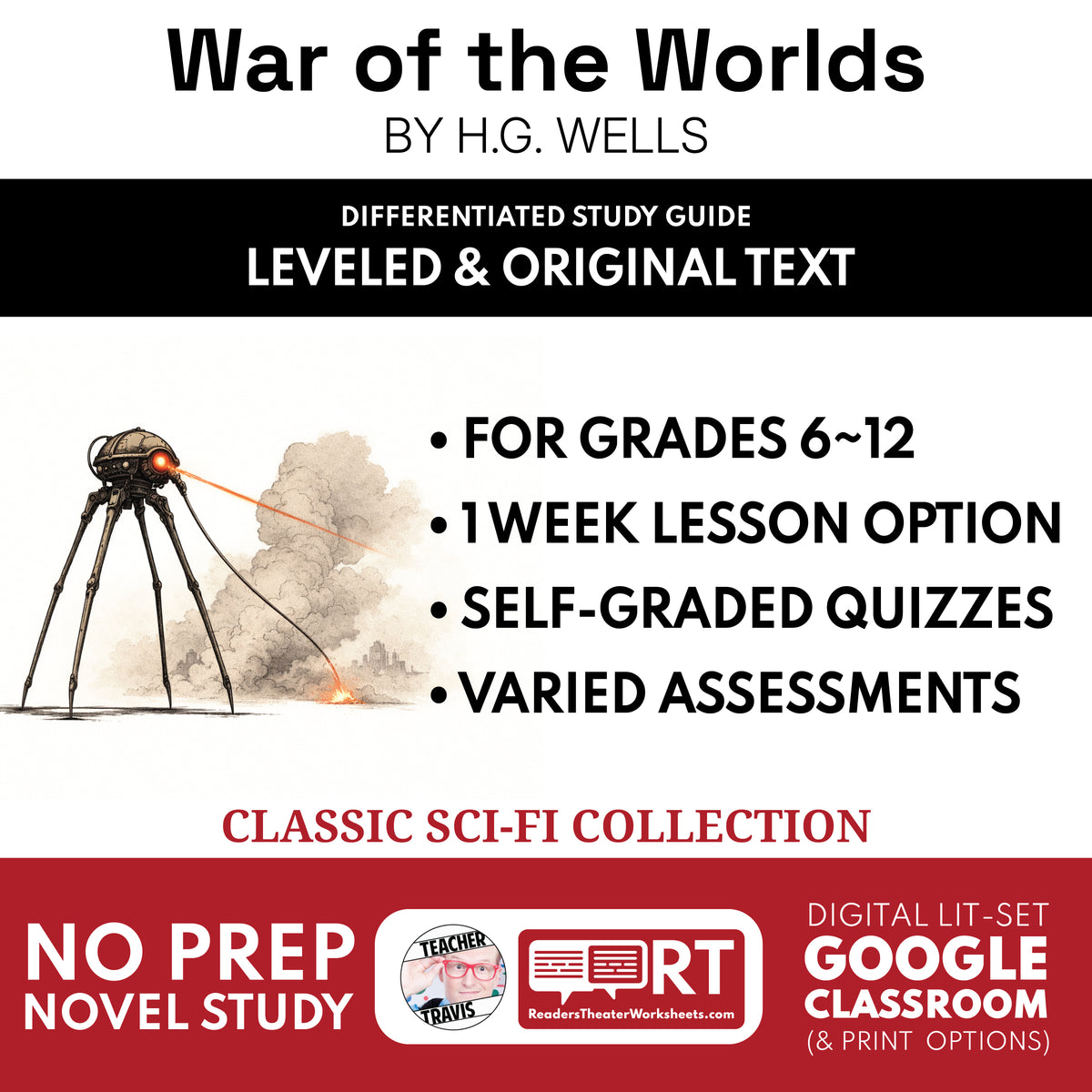
A differentiated classic science fiction study guide for grades 6–12 with original and leveled reading paths, vocabulary, discussion questions, student assessment, self-graded quiz support, and teacher materials for mixed-level ELA classrooms.
Classroom Uses Close Reading, Discussion, Assessment, Review, Enrichment, Intervention, Homework view all
- Close Reading
- Discussion
- Assessment
- Review
- Enrichment
- Intervention
- Homework
Included Original Text, Leveled Text, Teacher Guide, Student Worksheet, Answer Key, Quiz, Google Forms Quiz, Vocabulary, Discussion Questions, Challenge Questions, Writing Prompt view all
- Original Text
- Leveled Text
- Teacher Guide
- Student Worksheet
- Answer Key
- Quiz
- Google Forms Quiz
- Vocabulary
- Discussion Questions
- Challenge Questions
- Writing Prompt
Format PDF, DOCX, Google Docs, Google Slides, Google Forms, ZIP Download, Online Library Access, Printable, Editable view all
- DOCX
- Google Docs
- Google Slides
- Google Forms
- ZIP Download
- Online Library Access
- Printable
- Editable
Differentiation Leveled Version, Original Version, Mixed Reading Levels, Struggling Readers, Advanced Readers, Vocabulary Support view all
- Leveled Version
- Original Version
- Mixed Reading Levels
- Struggling Readers
- Advanced Readers
- Vocabulary Support
Make The War of the Worlds easier to teach without flattening the panic, suspense, invasion imagery, or social criticism that make H. G. Wells's novel worth reading. This resource gives teachers a classroom-ready dual-track novel study with the full original text path, a faithful five-part adapted path, discussion support, vocabulary work, short-answer assessment, challenge questions, and 5 self-graded multiple-choice quizzes.
Problem: The War of the Worlds is exciting enough to hook students, but its shifting viewpoints, Victorian news-style narration, military references, London exodus scenes, and layered critique of empire and human pride can leave mixed-ability classes uneven. Some students can follow the Martian action but miss the evidence trail, while others are ready to analyze the original style, the Thunder Child sequence, the artilleryman, the curate, and the bacteria ending in more depth.
Here’s the solution: This resource gives you two practical reading tracks for the same novel. Students can read the original public-domain text for a more rigorous close-reading experience, use the adapted five-part version for access and pacing, or move between both versions in a dual-track plan. The adapted text preserves the major invasion scenes, the core character conflicts, the London panic, the ruined-house occupation, the climax in dead London, and the epilogue, so the class can stay together even when students need different reading supports.
Easy to Use with Mixed-Ability Readers
The discussion questions, self-graded MC quizzes, short-answer items, and challenge questions work across both tracks. That means you can keep mixed-ability groups aligned around the same plot points, themes, vocabulary, and evidence-based thinking while still giving stronger readers room for original-text comparison and deeper interpretation.
Perfect for
- Grades 6–12 classic science fiction novel study
- Invasion literature and social criticism units
- Intervention-supported reading
- Substitute-ready review
- Small-group differentiation
This product includes a zip file consisting of:
NOTE: All files are editable and include print/digital versions (PDF, DOCX, PPTX, Google Docs/Slides/Forms)
Full Original Text:
- ~60,800 words
- ~8.8 Flesch-Kincaid GL
- ~Lexile 1050L–1250L
- ~CEFR B2–C1
Best fit for confident readers who can track Victorian narration, shifting viewpoints, invasion logistics, social criticism, and layered irony about empire, technology, and human pride.
Leveled Text:
- ~12,750 words
- ~4.5 Flesch-Kincaid GL
- ~Lexile 650L–800L
- ~CEFR A2–B1
Best fit for students who benefit from clearer pacing, shorter reading chunks, and a stable sequence of events before discussion or original-text comparison.
Student Final Worksheet/Quizzes
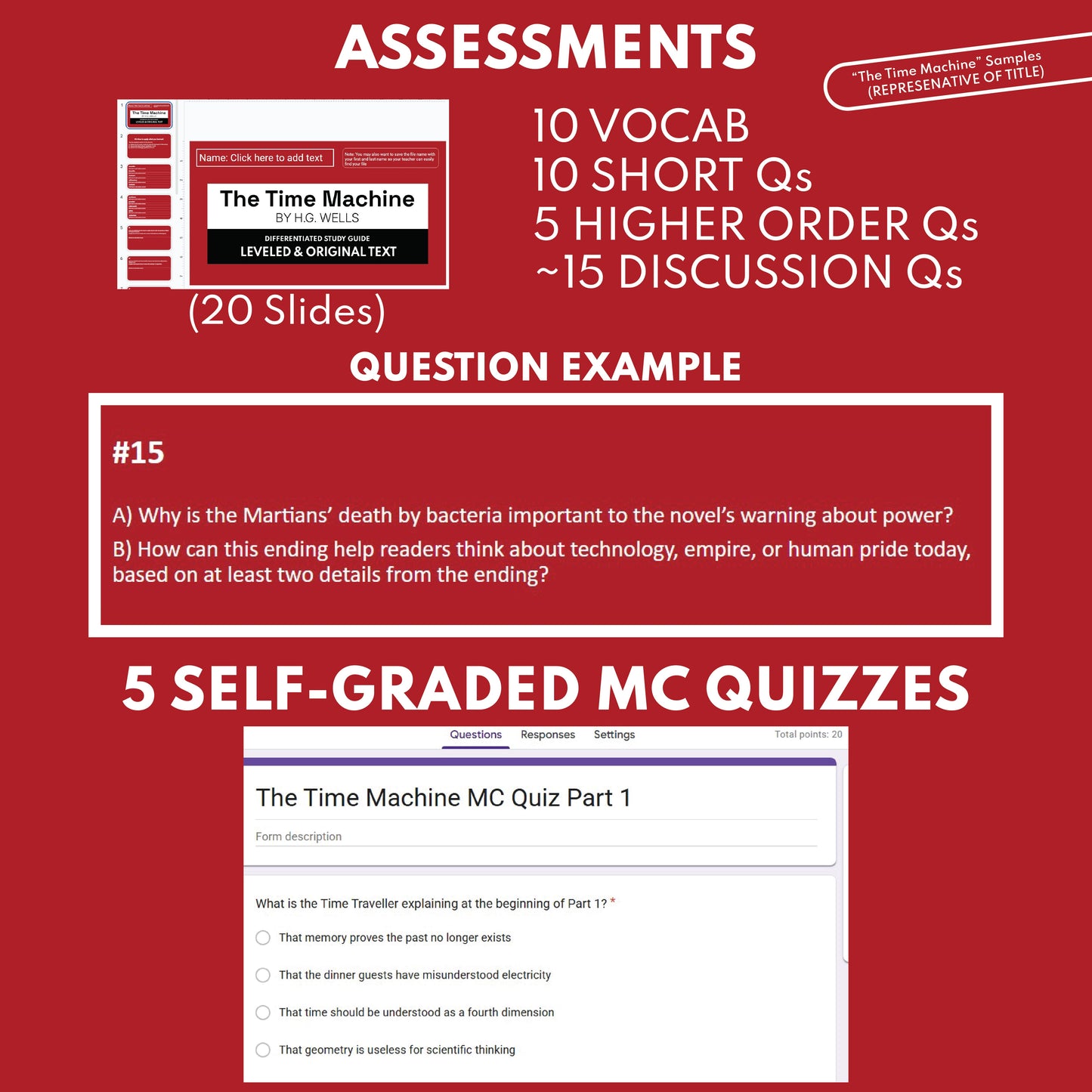
- 10 Vocabulary Words
- 10 Short Answer Recall/Comprehension
- 5 Challenge Questions (synthesis, analysis, themes, real life connection)
- 5 Multiple Choice Quizzes (20 Questions) (1 per part)
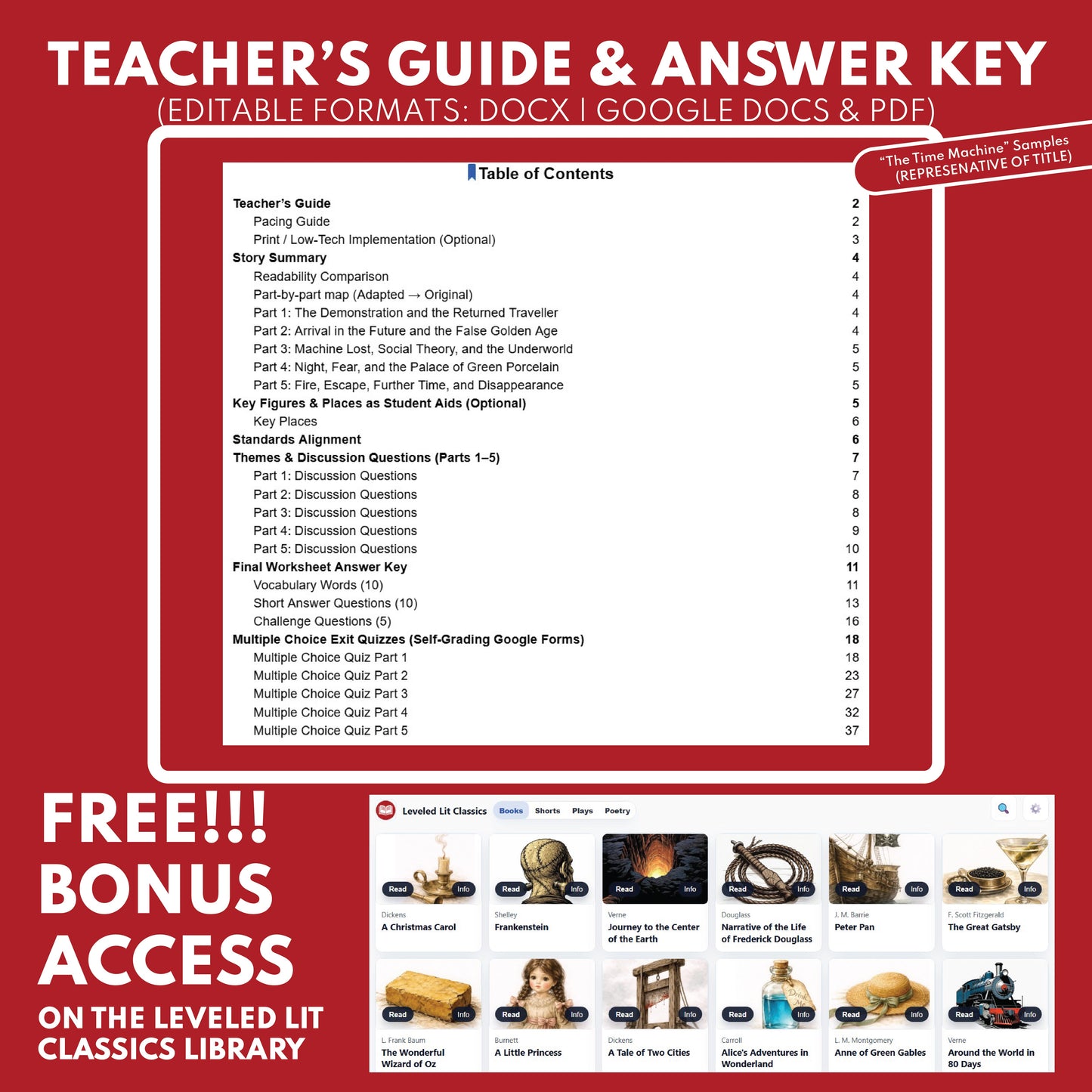
Teacher’s Guide & Answer Key
- 5 Sets of Daily Discussion Questions (1 per part)
- 5 Sets of Self-Graded Exit Quizzes (1 per part, 20Qs each)
- Answer Keys for Vocab, Short Answer, and Challenge Questions
- Key Figures & Places reference sheets to help students track characters and settings
FREE BONUS ALERT!
- Free Access Code to the text on the Leveled-Lit Classics Library!
- Save paper, read the text on a kindle-flow style app on any device, no student login/passwords needed.
Summary of 5 Part Leveled Text
Part 1 – Mars changes from a distant object of scientific curiosity into the source of a real attack. Ogilvy, the narrator, and the crowd at Horsell Common move from observation to shock as the cylinder opens, the first Martian appears, and the Heat-Ray destroys the hope that ordinary rules can protect them.
Part 2 – The invasion spreads across Surrey, forcing the narrator to think first of his wife and then of survival. Flight, storm, artillery, the damaged Martian machine near Weybridge, and the Black Smoke all show that courage and weapons can matter briefly without restoring the world people thought they knew.
Part 3 – The viewpoint widens to London through the narrator’s brother as warnings arrive too late and the city breaks into exodus. Miss Elphinstone, Mrs Elphinstone, the crowded roads, and the Thunder Child sequence turn public collapse into a series of urgent choices, ending with a fierce but limited act of human resistance.
Part 4 – The ruined house traps the narrator and the curate close to a Martian pit, where watching becomes both knowledge and torment. Hunger, silence, the handling-machine, Martian feeding, the curate’s collapse, and the red weed make occupation intimate and morally painful before the narrator escapes into a changed landscape.
Part 5 – Putney Hill offers a false vision of organized survival through the artilleryman, but his talk outruns his discipline. Dead London seems to confirm human defeat until the narrator discovers the dead Martians on Primrose Hill, returns to his wife, and enters an epilogue where relief remains shadowed by memory and future fear.
Pacing Guide
Adapted-Only Track (Fastest: 5-Day Model)
- Best for classes that need a manageable, one-week novel experience.
- Day 1–5: Students read one adapted part per day and use the matching discussion questions and self-grading multiple-choice exit quiz.
- End of week: Use the Final Worksheet (Vocabulary Words, Short Answer Questions, and Challenge Questions) as a whole-book check.
- This track keeps the lessons tight, predictable, and finishable in five days while still giving younger readers a full sense of the story.
Original-Only Track (Longer: Multi-Day Per Section)
- Best for stronger readers or classes ready for the full language and reading level of the original novel.
- Students read the original chapters aligned to each adapted Part (as listed in the Differentiation Planning Guide: Original vs Adapted Versions).
- Use the same Discussion Questions, Multiple Choice Exit Quizzes, and Final Worksheet sections.
- Vocabulary Words (10) are still usable because each word appears in both the adapted text and the corresponding original chapters, with quotes from both versions.
- This track preserves full style, pacing, and detail of the classic novel while still giving you ready-made, age-appropriate assessments.
Dual-Track Differentiation (Mixed Readers, Flexible Timelines)
- Best when you have a range of reading levels in and want everyone on the same story events.
- Assign the adapted Part (1–5) to students who need a shorter, clearer text.
- Assign the matching original chapters to students ready for the full novel (chapter ranges are spelled out in the Story Summary section of the full Teacher's Guide).
- All assessments are usable for both tracks: per-part Discussion Questions, per-part MC Exit Quizzes, and the Final Worksheet (Vocabulary, Short Answer, and Challenge Questions).
- Original-text readers may take 2+ days per section while adapted-text readers can:
- Reread key scenes,
- Work with the Vocabulary Words,
- Answer the Discussion Questions in pairs or small groups.
Frequently Asked Questions
Can I use this if some students read the original and others read the adapted version?
Yes. The guide is built for that exact classroom problem. Both tracks follow the same five-part map, so discussion, vocabulary, short-answer questions, challenge questions, and quiz review can stay aligned.
Are the multiple-choice quizzes included?
Yes. The final DOCX includes the canonical self-graded MC quiz for all five parts. Each question keeps its embedded answer key, so students can use it for review, correction, or independent check-for-understanding work.
Does the adapted version skip the ending or soften the darker scenes?
No. The adapted version keeps the cylinder, the Heat-Ray, the Black Smoke, the Thunder Child, the ruined-house sequence, the curate, the artilleryman, dead London, the bacterial reversal, and the epilogue.
Can this work for a short unit?
Yes. The five adapted parts can support a compact one-week reading plan, while the original text can be used for selected close-reading passages, extension groups, or comparison work.
Is the vocabulary tied to the text?
Yes. The ten vocabulary words are verified against both the adapted text and the mapped original source ranges, and the separate vocabulary proof report documents those matches.
Make sure this resource meets your needs and download a similar but 100% FREE differentiated study guide:
- The Great Gatsby Differentiated Novel Study Guide
- Narrative of the Life of Frederick Douglass Differentiated Study Guide
- Frankenstein by Mary Shelley Differentiated Gothic Lit Study Guide
- The Tell-Tale Heart Differentiated Study Guide
This The War of the Worlds novel study is designed for teachers who need a faithful, usable, differentiated resource that still respects Wells's original story. It gives you a clear reading path, practical assessment pieces, mixed-level flexibility, and enough depth for meaningful discussion about invasion, empire, panic, survival, technology, humility, and the limits of human power.
Share