
Readers Theater Worksheets
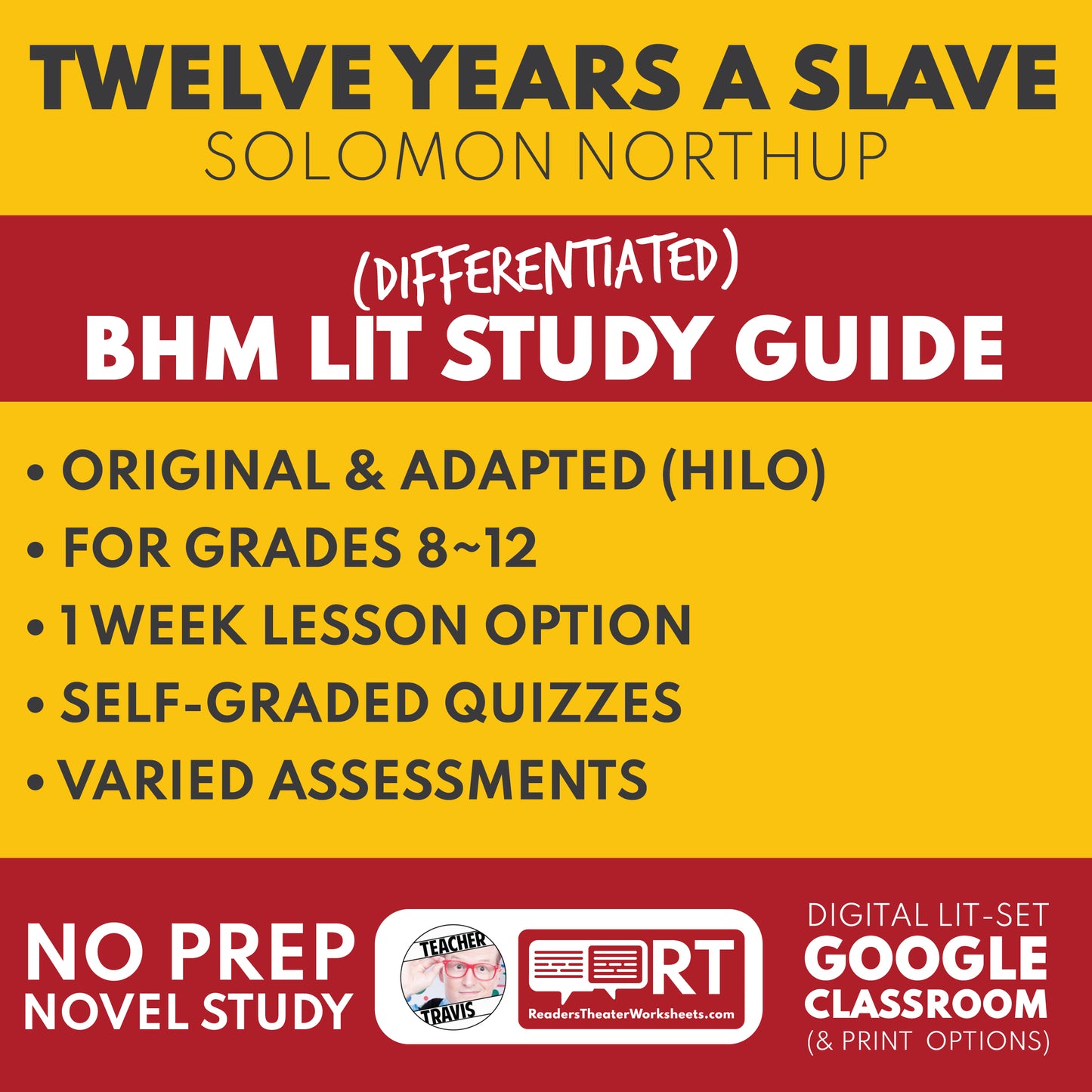
Twelve Years a Slave by Solomon Northup Differentiated Study Guide | Black History Month for High School Students
Twelve Years a Slave by Solomon Northup Differentiated Study Guide | Black History Month for High School Students
Couldn't load pickup availability
Classroom Use at a Glance
A no-prep differentiated literature study guide for Twelve Years a Slave. Includes original and leveled reading support, comprehension and analysis activities, vocabulary work, discussion prompts, quiz materials, and teacher support for mixed-ability ELA classes.
Classroom Uses Close Reading, Discussion, Assessment, Review, Homework, Sub Plan view all
- Close Reading
- Discussion
- Assessment
- Review
- Homework
- Sub Plan
Included Original Text, Leveled Text, Teacher Guide, Student Worksheet, Quiz, Google Forms Quiz, Answer Key, Vocabulary, Discussion Questions, Writing Prompt view all
- Original Text
- Leveled Text
- Teacher Guide
- Student Worksheet
- Quiz
- Google Forms Quiz
- Answer Key
- Vocabulary
- Discussion Questions
- Writing Prompt
Format PDF, DOCX, Google Docs, Google Forms, Printable, Editable view all
- DOCX
- Google Docs
- Google Forms
- Printable
- Editable
Differentiation Original Version, Leveled Version, Mixed Reading Levels, Vocabulary Support, Struggling Readers, Advanced Readers view all
- Original Version
- Leveled Version
- Mixed Reading Levels
- Vocabulary Support
- Struggling Readers
- Advanced Readers
PROBLEM: Most classic literature study guides break down in real classrooms for two reasons: the original text is long and demanding, and student reading levels inside one class are rarely uniform—so teachers end up building separate tracks or simplifying discussions until the unit loses rigor.
SOLUTION: This differentiated novel study / digital lit-set for Twelve Years a Slave by Solomon Northup solves that problem by giving you both the complete original text and a condensed, five-part adapted version, so you can keep the class moving together while students read at the level that fits.
Every discussion question, multiple-choice exit quiz, short-answer item, and challenge question works for both tracks, so you can run one coherent unit without rewriting prompts or splitting your class into separate novel study paths.
Perfect for Grades 8–10 ELA classrooms, intervention and inclusion settings, mixed-ability groups, and advanced/extension options—supporting close reading, theme tracing, character analysis, structure-based thinking, academic vocabulary development, and text-dependent writing without requiring separate lesson plans for different reading levels.
Quick Guide for Teachers
Adapted-Only Track (Fastest: 5-Day Model)
Best for Grades 9–12 classes that need a manageable, one-week novel experience. Day 1–5: Students read one adapted part per day and use the matching Main Ideas & Themes Discussion Questions and self-grading multiple-choice quiz. End the week with the Final Worksheet (Vocabulary Words, Short Answer Questions, and Challenge Questions). This track keeps lessons tight, predictable, and complete in five days.
Original-Only Track (Longer: Multi-Day Per Section)
Ideal for stronger readers or classes ready for original language and sentence structure. Students read the original chapters aligned to each adapted Part Use the same Discussion Questions, MC exit quizzes, and Final Worksheet; all items are text-accurate for both versions. Vocabulary Words (10) are usable for both tracks, because each word appears in both the adapted text and the corresponding original chapters. This track preserves the full descriptive style and classic voice while giving you ready-made, age-appropriate assessments.
Dual-Track Differentiation (Mixed Readers, Flexible Timelines)
Lets your entire class study the same plot, scenes, and themes at the same time—even when some students need the adapted text and others handle the full novel. Assign adapted Part 1 to students who need a shorter, clearer text and original corresponding chapters to students reading the full text; repeat this pattern through Parts 2–5 (timing will depend on your classroom's reading level) Give original-text students multiple days per section while adapted-text students reread key scenes, complete vocabulary tasks, and tackle discussion questions in pairs or small groups.
This product includes a zip file consisting of
NOTE: All files are editable and include (PDF, DOCX, PPTX, Google Docs/Slides/Forms)
Full Original Text: ~76,000 words | 10.0 Flesch-Kincaid GL
- Great for on-level Grades 11~12 readers, advanced Grades 8–10 readers, extension groups, longer-term novel studies.
Adapted Version Text: ~7,500 words | 8.0 Flesch-Kincaid GL
- On-level Grade 8 readers
- Designed for Grades 10-12 with support and access while preserving tone & style
- Supported readers who need a shorter text with the same plot, themes, and assessment alignment.
- *Both versions tell the same story, allowing students to participate in shared discussions even when reading different texts.
FREE BONUS ALERT!
Access Code included to the original and adapted/abridged text on the LEVELED-LIT CLASSICS Library Platform.
Student Final Worksheet/Quizzes (PPTX, Google Slides/Forms)
- 10 Vocabulary Words
- 10 Short Answer Recall/Comprehension
- 5 Challenge Questions (synthesis, analysis, themes, real life connection)
- 5 Multiple Choice Quizzes (20 Questions) (1 per part)
Teacher’s Guide & Answer Key
- 5 Sets of Daily Discussion Questions (1 per part)
- 5 Sets of Self-Graded Exit Quizzes (1 per part, 20Qs each)
- Answer Keys for Vocab, Short Answer, and Challenge Questions
- Key Figures & Places reference sheets to help students track characters and settings
How can I be sure this resource will meet my needs?
1) Open the preview thumbnail and read the first page excerpt of the Adapted Version to see if the text is suitable for your classroom's reading level.
2) First, try a similar FREE RESOURCE:
3) Also, you can test drive these other digital lit sets for FREE!
- [FREE DOWNLOAD] The Great Gatsby Differentiated Novel Study
- [FREE DOWNLOAD] Adapted Peter Pan Differentiated Novel Study
- [FREE DOWNLOAD] The Wonderful Wizard of Oz Adapted Version
- [FREE DOWNLOAD] A Christmas Carol Adapted Version
Get all 5 BHM Study Guides & Save 40% here!
What’s the Tradeoff of Using the Adapted Version?
Pros:
- Reduces the novel to a fraction of its original length, fitting neatly into a one-week unit.
- Well suited for shorter attention spans and developing readers in Grades 9-10
- Preserves core narrative elements, characters, and themes
- Far better than skipping the book entirely due to time limits or reading-level concerns.
- Works for whole-class read-alouds, small-group novel studies, independent reading, or focused close-reading lessons.
Cons:
- Omits some original language, side scenes, and descriptive passages for brevity, so students do not see every nuance of the original author's style.
- Leaves fewer opportunities for deep line-by-line stylistic analysis than a full-length, multi-week novel study.
Adapted Version Summary (and source chapters)
Part 1 – From Freedom to the Slave Pen
Adapted from: Chapters I–III of the original novel.
Solomon establishes his free life—family, work, and community—before being drawn into travel by men who appear respectable and trustworthy. Once isolated from his supports, he is drugged and confined, and his spoken truth is treated as defiance rather than evidence. The Part ends with his violent “conversion” into property inside the Washington slave pen system.
Part 2 – Sold South: New Orleans and First Ownership
Adapted from: Chapters IV–VII of the original novel.
Solomon is transported south through confinement and commerce, culminating in a market routine designed to maximize profit and normalize cruelty. Renaming and forced presentation turn human beings into “products” meant to look valuable to buyers. Sold into Louisiana, Solomon enters plantation life under William Ford, where competence can reduce friction but cannot create real safety within ownership.
Part 3 – Tibeats: The Turn into Open Peril
Adapted from: Chapters VIII–XI of the original novel.
Under John Tibeats, brutality becomes immediate and personal as resentment escalates into open threats on Solomon’s life. The narrative highlights how “discipline” functions as terror when law protects the enslaver’s power. Solomon’s choices narrow into pure survival strategy as danger intensifies and long-term captivity becomes more certain.
Part 4 – Epps’s Plantation: Labor Regimes and Human Breakdown
Adapted from: Chapters XII–XVIII of the original novel.
On Edwin Epps’s plantation, slavery is shown as an organized labor regime enforced through quotas, surveillance, and punishment. Household conflict, jealousy, illness, and sexual coercion intensify the violence, and Patsey’s suffering becomes a central moral wound. Tightening control makes resistance and hope increasingly dangerous, not only for Solomon but for everyone around him.
Part 5 – Bass and the Recovery of a Stolen Life
Adapted from: Chapters XIX–XXII of the original novel.
Samuel Bass offers a rare alliance grounded in principle and practical action, allowing Solomon’s hope to become a careful plan of secret communication and verification. The rescue unfolds through paperwork, travel, confrontation, and formal surrender of the ownership claim. The ending pairs reunion with the recognition that justice is limited and the damage of slavery cannot be fully undone.
Frequently Asked Questions
Can I use the adapted text for reluctant or below-level readers without changing my assessments?
Yes. The adapted version is approximately 7,500 words at a Flesch-Kincaid Grade Level of 8.0, and it follows the same Part structure as the original. Students can read either track while completing the same exit quizzes, short-answer prompts, and whole-book challenge questions.
Is this aligned to CCSS for Grades 8–10?
The tasks are built around RL.9–10 reading analysis skills (text evidence, theme development, character and structure analysis), SL.9–10 discussion expectations (collaborative, evidence-based conversation), and L.9–10 vocabulary standards (using context and academic language accurately). The standards list is kept lean to remain fully defensible.
How does the differentiation actually work in a real classroom?
Both versions follow the same Part 1–5 sequence and map directly to the original chapters (I–XXII). You can assign the adapted version to support access and pace while assigning the original to advanced readers, then run the same checkpoint schedule for the whole class—differentiating only the reading load and the depth of evidence you require in responses.
This is a complete, no-prep unit that lets you teach Twelve Years a Slave with one coherent assessment system while students read either the full original or the adapted five-part text.
Standards
Reading Literature: CCSS RL.9-10.1, CCSS RL.9-10.2, CCSS RL.9-10.3, CCSS RL.9-10.4, CCSS RL.9-10.5, CCSS RL.9-10.6
Writing: CCSS W.9-10.1, CCSS W.9-10.2
Speaking & Listening: CCSS SL.9-10.1
Language: CCSS L.9-10.4
Anchor Standards: CCRA.R.1, CCRA.R.2, CCRA.R.3, CCRA.R.4, CCRA.R.5, CCRA.W.1, CCRA.W.2, CCRA.SL.1, CCRA.L.4
Share