
Readers Theater Worksheets
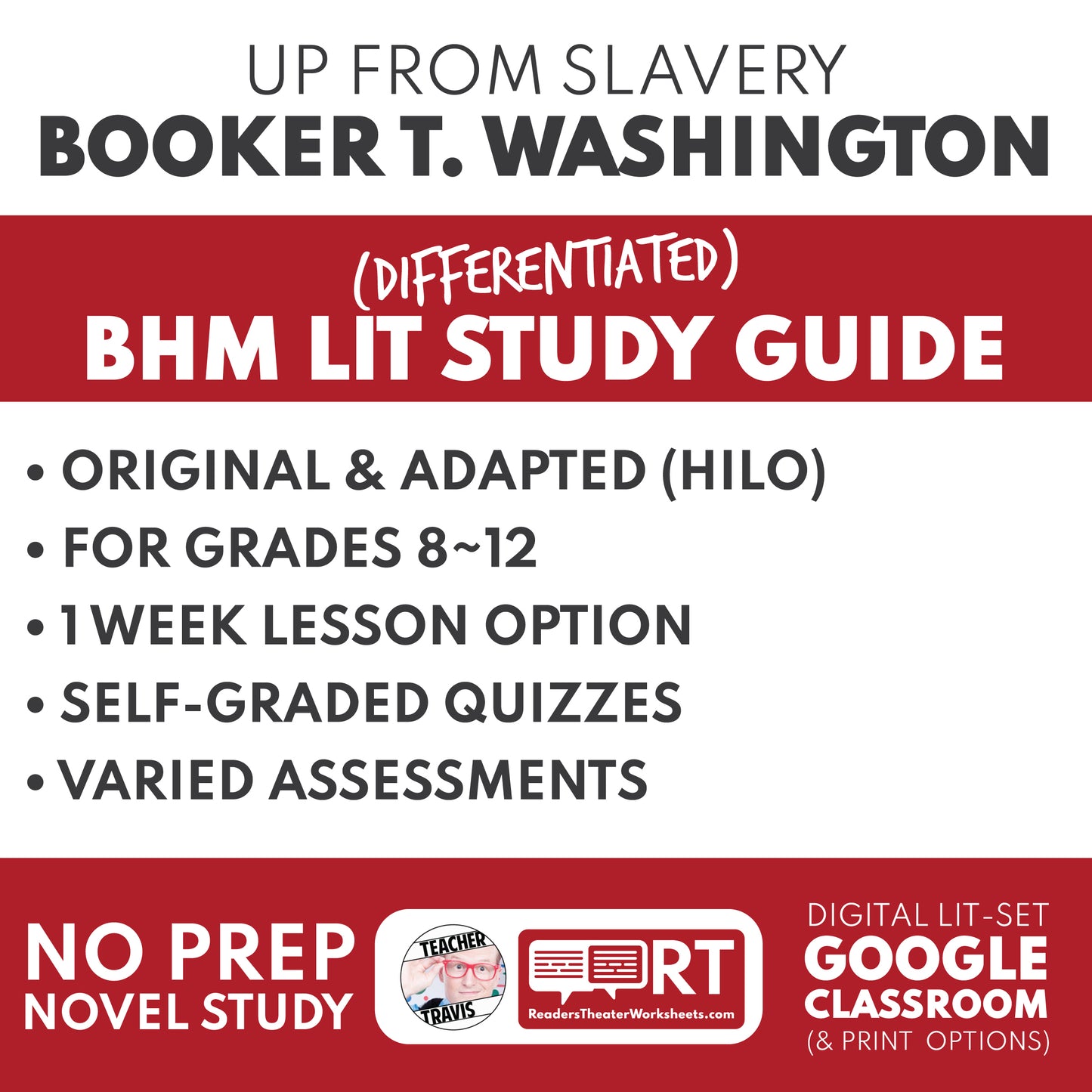
Up from Slavery by Booker T. Washington Differentiated Study Guide | Black History Month for High School Students
Up from Slavery by Booker T. Washington Differentiated Study Guide | Black History Month for High School Students
Couldn't load pickup availability
Classroom Use at a Glance
A no-prep differentiated literature study guide for Up from Slavery. Includes original and leveled reading support, comprehension and analysis activities, vocabulary work, discussion prompts, quiz materials, and teacher support for mixed-ability ELA classes.
Classroom Uses Close Reading, Discussion, Assessment, Review, Homework, Sub Plan view all
- Close Reading
- Discussion
- Assessment
- Review
- Homework
- Sub Plan
Included Original Text, Leveled Text, Teacher Guide, Student Worksheet, Quiz, Google Forms Quiz, Answer Key, Vocabulary, Discussion Questions, Writing Prompt view all
- Original Text
- Leveled Text
- Teacher Guide
- Student Worksheet
- Quiz
- Google Forms Quiz
- Answer Key
- Vocabulary
- Discussion Questions
- Writing Prompt
Format PDF, DOCX, Google Docs, Google Forms, Printable, Editable view all
- DOCX
- Google Docs
- Google Forms
- Printable
- Editable
Differentiation Original Version, Leveled Version, Mixed Reading Levels, Vocabulary Support, Struggling Readers, Advanced Readers view all
- Original Version
- Leveled Version
- Mixed Reading Levels
- Vocabulary Support
- Struggling Readers
- Advanced Readers
PROBLEM: Most classic literature study guides break down in real classrooms for two reasons: the original text is long and demanding, and student reading levels inside one class are rarely uniform—so teachers end up building separate tracks or simplifying discussions until the unit loses rigor.
SOLUTION: This differentiated novel study / digital lit-set for Up from Slavery by Booker T. Washington solves that problem by giving you both the complete original text and a condensed, five-part adapted version, so you can keep the class moving together while students read at the level that fits.
Every discussion question, multiple-choice exit quiz, short-answer item, and challenge question works for both tracks, so you can run one coherent unit without rewriting prompts or splitting your class into separate novel study paths.
Perfect for Grades 9–10 classrooms focused on evidence-based discussion and writing, theme and central-idea analysis, character and leadership analysis, and academic vocabulary development aligned to RL/SL/L expectations.
Quick Guide for Teachers
Adapted-Only Track (Fastest: 5-Day Model)
Best for Grades 9–12 classes that need a manageable, one-week novel experience. Day 1–5: Students read one adapted part per day and use the matching Main Ideas & Themes Discussion Questions and self-grading multiple-choice quiz. End the week with the Final Worksheet (Vocabulary Words, Short Answer Questions, and Challenge Questions). This track keeps lessons tight, predictable, and complete in five days.
Original-Only Track (Longer: Multi-Day Per Section)
Ideal for stronger readers or classes ready for original language and sentence structure. Students read the original chapters aligned to each adapted Part Use the same Discussion Questions, MC exit quizzes, and Final Worksheet; all items are text-accurate for both versions. Vocabulary Words (10) are usable for both tracks, because each word appears in both the adapted text and the corresponding original chapters. This track preserves the full descriptive style and classic voice while giving you ready-made, age-appropriate assessments.
Dual-Track Differentiation (Mixed Readers, Flexible Timelines)
Lets your entire class study the same plot, scenes, and themes at the same time—even when some students need the adapted text and others handle the full novel. Assign adapted Part 1 to students who need a shorter, clearer text and original corresponding chapters to students reading the full text; repeat this pattern through Parts 2–5 (timing will depend on your classroom's reading level) Give original-text students multiple days per section while adapted-text students reread key scenes, complete vocabulary tasks, and tackle discussion questions in pairs or small groups.
How can I be sure this resource will meet my needs?
1) Open the preview thumbnail and read the first page excerpt of the Adapted Version to see if the text is suitable for your classroom's reading level.
2) First, try a similar FREE RESOURCE:
3) Also, you can test drive these other digital lit sets for FREE!
- [FREE DOWNLOAD] The Great Gatsby Differentiated Novel Study
- [FREE DOWNLOAD] Adapted Peter Pan Differentiated Novel Study
- [FREE DOWNLOAD] The Wonderful Wizard of Oz Adapted Version
- [FREE DOWNLOAD] A Christmas Carol Adapted Version
Get all 5 BHM Study Guides & Save 40% here!
This product includes a zip file consisting of:
NOTE: All files are editable and include (PDF, DOCX, PPTX, Google Docs/Slides/Forms)
Full Original Text: ~76,000 words | 10.8 Flesch-Kincaid GL
- Lexile Ranges: ~1140L - 1450L | CEFR ~C1
- Great for advanced readers (Grades 9–10), extension groups, longer-term novel studies.
Adapted Version Text: ~17,000 words | 9 Flesch-Kincaid GL
- Lexile Ranges: ~1050L - 1360L | CEFR ~B2
- On-level Grade 9 readers Supported Grade 8 readers
- Designed for Grades 10-12 with support and access while preserving tone & style
- Supported readers who need a shorter text with the same plot, themes, and assessment alignment.
- *Both versions tell the same story, allowing students to participate in shared discussions even when reading different texts.
FREE BONUS ALERT!
Access Code included to the original and adapted/abridged text on the LEVELED-LIT CLASSICS Library Platform.
Student Final Worksheet/Quizzes (PPTX, Google Slides/Forms)
- 10 Vocabulary Words
- 10 Short Answer Recall/Comprehension
- 5 Challenge Questions (synthesis, analysis, themes, real life connection)
- 5 Multiple Choice Quizzes (20 Questions) (1 per part)
Teacher’s Guide & Answer Key
- 5 Sets of Daily Discussion Questions (1 per part)
- 5 Sets of Self-Graded Exit Quizzes (1 per part, 20Qs each)
- Answer Keys for Vocab, Short Answer, and Challenge Questions
- Key Figures & Places reference sheets to help students track characters and settings
What’s the Tradeoff of Using the Adapted Version?
Pros:
Reduces the text to a fraction of its original length, fitting neatly into a one-week unit. Well suited for shorter attention spans and developing readers in Grades 9-10 Preserves core narrative elements, characters, and themes Far better than skipping the book entirely due to time limits or reading-level concerns. Works for whole-class read-alouds, small-group novel studies, independent reading, or focused close-reading lessons.
Cons:
Omits some original language, side scenes, and descriptive passages for brevity, so students do not see every nuance of the original author's style. Leaves fewer opportunities for deep line-by-line stylistic analysis than a full-length, multi-week novel study.
Adapted Version Summary (and source chapters)
Part 1 – From Slavery to the Hunger for School Adapted from: Chapters I–II of the original novel. Washington describes the physical hardships and instability of his early life under slavery and the confusing transition into freedom. As his family struggles through poverty and exhausting labor, he becomes fixated on schooling as the clearest path toward dignity and direction. The section ends with his growing sense that education is not a luxury but the foundation for real independence.
Part 2 – The Fight for Education and the First Steps into Leadership Adapted from: Chapters III–VI of the original novel. He pursues education against distance, money, and circumstance, and encounters training that ties learning to discipline and work. He begins teaching and speaking, testing his leadership while observing how status-seeking ambitions can outrun real preparation. By the end of this stretch, his responsibilities expand and he is pointed toward the mission that will define his life at Tuskegee.
Part 3 – Tuskegee Begins: Improvisation, Standards, and Survival Adapted from: Chapters VII–IX of the original novel. Arriving in Tuskegee, Washington finds intense need and almost no infrastructure, forcing him to begin with improvised spaces and minimal resources. He sets strict expectations for order, cleanliness, and usefulness, treating daily habits as the school’s first curriculum. The narrative shows skepticism, anxiety, and constant pressure as the institution fights simply to keep going.
Part 4 – Building an Institution: Work as Training, Money as a Constant Problem Adapted from: Chapters X–XIII of the original novel. Tuskegee grows by turning labor into instruction and by training students to build, maintain, and take ownership of the institution itself. Washington struggles to sustain quality while expanding, facing shortages, misunderstandings, and the relentless need to persuade supporters. Fundraising and travel become essential, and the school’s survival increasingly depends on public credibility and carefully built alliances.
Part 5 – National Turning Point and Closing Reflections Adapted from: Chapters XIV–XVII of the original novel. The Atlanta Exposition address becomes a public turning point, putting Washington’s philosophy before a massive audience and national press. Wider speaking demands and public scrutiny reshape his work, including travel and international exposure. The memoir closes with reflections on leadership, endurance, personal habits, and long-term aims tied to Tuskegee’s mission.
Frequently Asked Questions About the Adapted Up from Slavery Novel Study
Can I use the adapted text with reluctant or below-level readers without changing the assessments?
Yes. The adapted version is a complete five-part text (about 17,000 words at FKGL 9) mapped directly to the original chapters, and the same assessments are designed to work with either reading track.
Is this aligned to high school CCSS skills for Grades 9–10?
Yes. The unit emphasizes text evidence, theme/central-idea development, character and leadership analysis, academic vocabulary, and structured discussion aligned to RL/SL/L clusters for grades 9–10.
How does the differentiation actually work in one classroom?
Assign the original or adapted version by student need, keep everyone on the same part pacing, and require evidence from whichever version they are reading—because each part’s tasks are built to be answerable from both the adapted text and the mapped original chapters.
This is a complete, no-prep unit that keeps one class moving together with a dual-track text system—original and adapted—without rewriting prompts or sacrificing rigor.
Standards
Reading Literature: CCSS RL.9-10.1, CCSS RL.9-10.2, CCSS RL.9-10.3, CCSS RL.9-10.4, CCSS RL.9-10.5, CCSS RL.9-10.6
Writing: CCSS W.9-10.1, CCSS W.9-10.2
Speaking & Listening: CCSS SL.9-10.1
Language: CCSS L.9-10.4
Anchor Standards: CCRA.R.1, CCRA.R.2, CCRA.R.3, CCRA.R.4, CCRA.R.5, CCRA.W.1, CCRA.W.2, CCRA.SL.1, CCRA.L.4
Share